Alartx – Unified Security Infrastructure for Enterprise-Scale Institutions
Project Overview
Large banks often grow branch by branch, city by city, until their security infrastructure becomes a patchwork of devices, vendors, and legacy systems. Intrusion panels in one region, fire alarms from another supplier, CCTV streams in varying formats — all operating, but rarely together.
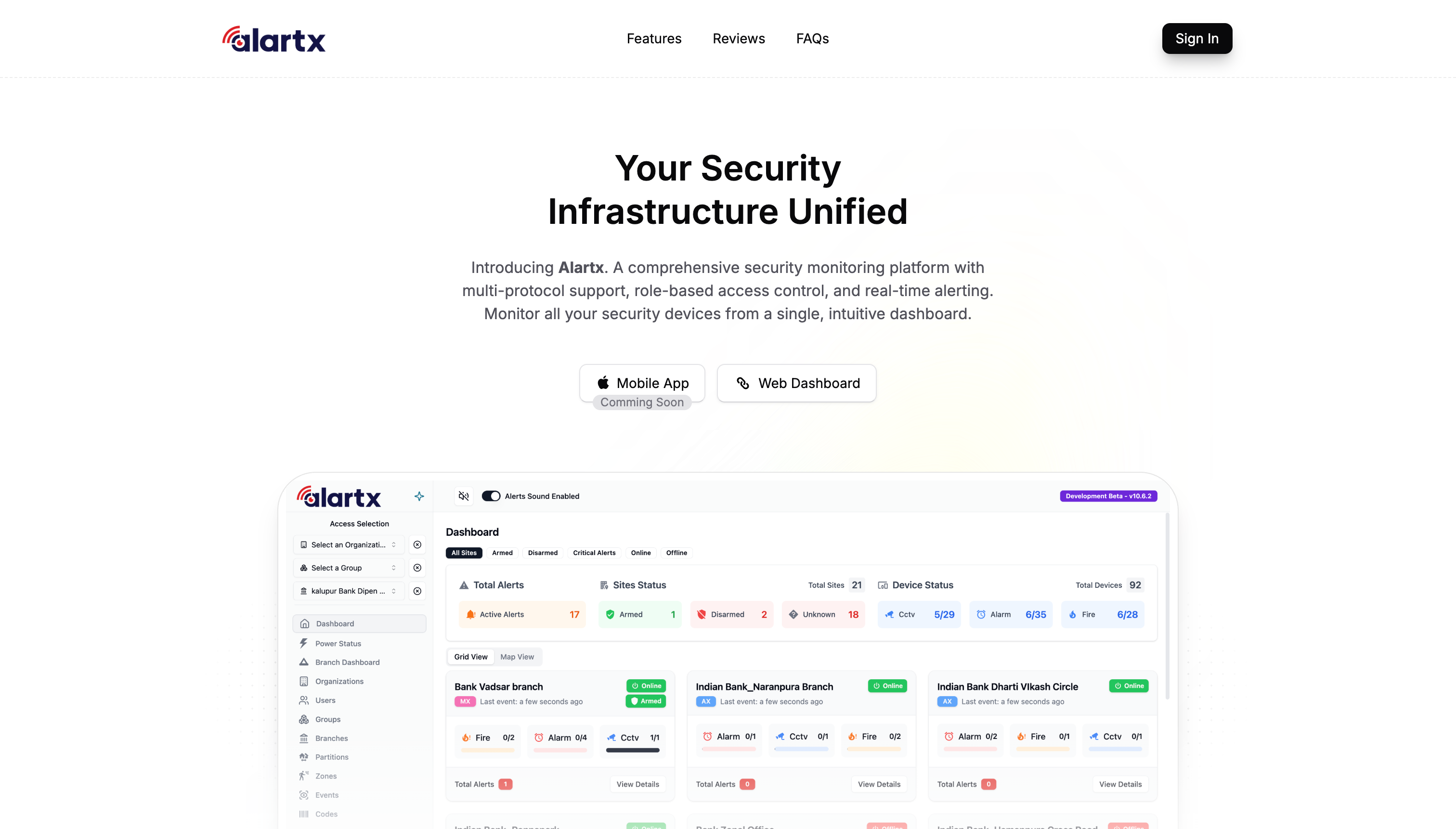
Our team set out to build a platform that could bring coherence to this landscape. Alartx became that platform: a unified security management system capable of integrating multi-protocol devices, monitoring thousands of endpoints, and offering a single, real-time view of an organisation’s security posture.
Today, it is used by leading banks across India to manage the security of their nationwide branch networks.
What challenge were we trying to solve?
How do you create one calm, reliable command centre from hundreds of disconnected systems?
This question shaped every design decision. Banks needed:
- A single dashboard for all locations
- Real-time visibility into alarms, device health, and incidents
- Support for legacy and modern devices across multiple protocols
- A role structure that mirrors the organisation’s real hierarchy
- A platform that could scale without breaking
The answer required more than software—it required rethinking how institutions “listen” to their security infrastructure.
How did we approach the solution?
We focused on building a system that feels unified even when the underlying devices are not.
1. Multi-protocol Device Integration
We designed the platform to speak multiple languages — SIA DC-09, CID, MQTT, and custom protocols — ensuring that nearly any alarm panel, CCTV interface, or monitoring device could connect without replacing existing hardware.
2. Enterprise-wide Monitoring
The dashboard offers:
- Live status across branches and regions
- Health monitoring for every connected device
- Real-time alarms with instant notifications
- Visual maps showing branch-zone conditions
Rather than overwhelming users, the interface was crafted to feel calm even when the data is dense.
3. Role-Based Access Control (RBAC)
Security teams in banks have complex hierarchies. We implemented RBAC so that each level — from a single branch to national command centres — sees what is relevant, nothing more.
4. Deployment at Scale
Our team handled migrations from legacy systems, coordinated device onboarding across regions, and ensured that the platform could grow with each new branch added.
Key Capabilities
- Unified dashboard across all branches
- Multi-protocol device support
- Real-time alerts and notifications
- Zone- and region-based hierarchies
- User and role management reflecting real organisational structure
- Detailed reporting and audit trails
- Visual geography-based monitoring
- API integrations for extended workflows
Impact for Clients
Banks using Alartx report clearer oversight, faster incident response, and reduced operational complexity. Instead of juggling multiple systems, teams work from one consistent source of truth.
Some quiet but meaningful outcomes include:
- A smoother daily workflow for security operations teams
- Fewer missed device failures or silent alarms
- Predictable expansion as new branches come online
- Better coordination between branch, regional, and headquarters teams
The platform doesn’t just show what is happening — it helps institutions understand their security ecosystem as a whole.
A reflective insight
When many systems finally speak through one interface, something interesting happens:
Incidents become patterns, patterns become insights, and insights become decisions.
Alartx was built to enable that transition — from reaction to understanding.