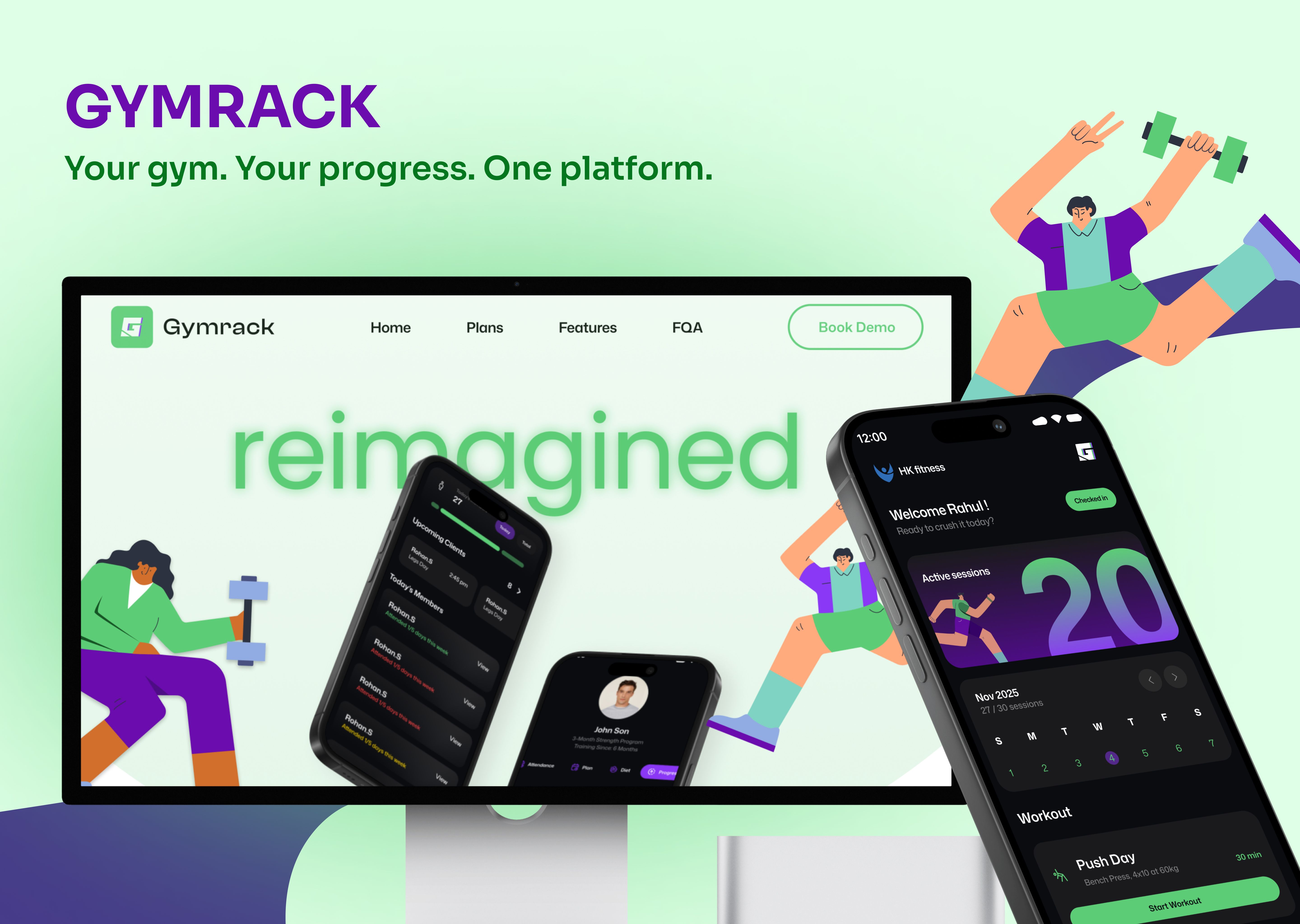
Gymrack is Stacknyu's own gym management platform — not a client build. It ships as two native apps: one for gym owners and staff, one for members, live on both the App Store and Google Play. More than 200 gyms use it today, and the team has shipped continuous updates since launch, most recently adding an in-app feedback tool so users can report bugs and request features directly.
Who This Is Built For
- Independent gyms and small chains replacing spreadsheets and disconnected billing tools
- Gym owners who need attendance, billing, trainers and leads in one dashboard instead of four separate tools
- Gym members who want their membership, renewals and progress in one app
- Independent trainees who want a workout tracker with no gym account required
The Challenge
Most gym software on the market leads with billing — memberships, recurring payments, invoicing — and treats attendance, trainer coordination and member progress as secondary features bolted onto a payments platform. Gym teams end up running a payments tool, a spreadsheet for attendance, a group chat for trainer assignments, and a separate app or none at all for member progress. Stacknyu built Gymrack to test a different starting point: put operations — check-ins, plans, trainer roles, leads — and the member's own experience on equal footing, in one product, and ship it as a real business rather than a portfolio demo.
Why Build It Instead of Buying It
The gym software market is crowded, and nearly every option in it is a billing platform first. That's the right shape for a lot of gyms — chasing failed payments and managing recurring subscriptions is a real, constant problem, and dedicated billing-first tools solve it well. Gymrack isn't trying to out-bill the billing specialists. It exists for gyms and independent trainers whose bigger daily friction is elsewhere: knowing who's actually in the building right now, keeping trainer assignments and workloads visible, and giving members something they'll actually open — not just a payment portal they check once a month.
The Product
Gymrack ships as two apps. The Admin app gives owners and staff live attendance tracking with occupancy visibility, membership plan and renewal management, billing, trainer and role assignment across the team, and QR-based lead capture that turns walk-in interest into a tracked, convertible lead. The Member app does two jobs from one codebase: for someone at a Gymrack gym, it's their membership, renewal status and activity in one place; for someone training on their own, the same app works standalone as a workout and progress tracker with no gym account needed at all.
Shipping in the Open
Gymrack is early — that's the honest part of this story, not something to hide. The Admin app has shipped more than nine tracked releases since its first version: a major backend upgrade for authentication and data reliability, an in-app feedback tool that routes bug reports and feature requests straight to the team, QR-based lead sharing, and steady stability fixes. On the member side, when users flagged that they couldn't log certain exercises, the team shipped custom exercise logging within days and said so publicly in reply to the review. That loop — real users, real complaints, visible fixes — is the actual state of the product, not a polished case study after the fact.
Where It Stands
More than 200 gyms use Gymrack today, running attendance, billing, trainer coordination and member engagement through one pair of apps instead of a stack of disconnected tools. Pricing is still in its free introductory phase while the team gathers usage data across a growing base, and the product roadmap is driven directly by what gym owners and members report using the in-app feedback tool. For Stacknyu, Gymrack is the proof that the team doesn't just deliver client platforms — it owns and operates a live consumer SaaS product, iterates on it in public, and answers to real app-store reviews the same way a client would expect it to answer to them.