AI-assisted products become more reliable when users can inspect the context behind an answer, see what is missing, and improve it over time. A profile workspace turns scattered details, documents, and connected history into something a person can review before an agent acts on it. The goal is not a larger prompt. It is a clearer operating record for people and software agents.
Who This Is For
- Product teams turning a chat prototype into a repeatable workflow
- Operations teams whose records live across profiles, notes, documents, and shared tools
- Founders building agent features that need user review and clear permission boundaries
- Teams that need AI to work from current, attributable information rather than a vague conversation history
Why a chat history is not a workspace
A conversation can be useful for a single task, but it is a weak place to store operating context. Important details fall out of view, facts become hard to verify, and the next person cannot tell which information is current. That gets riskier when the software can retrieve records, draft work, or trigger an action.
The better boundary is a workspace with durable objects: a profile, its source documents, relationships, activity history, and a visible next action. The chat can then become an interface to that structure instead of becoming the structure itself.
Make the context model visible
A user should be able to answer four questions without asking the assistant: what information exists, where it came from, what is missing, and what can be changed. That means the product needs explicit surfaces for saved details, connected documents, coverage by area, and the relationships that make a fact useful.
Do not hide this model behind a confidence score. A percentage with no explanation asks users to trust an opaque system. A useful readiness view instead names the missing field, stale document, or unresolved relationship and gives the user a way to correct it.
Retrieve less, but retrieve it with provenance
More context is not automatically better context. Large, unfiltered retrieval sets make answers harder to inspect and can bury the relevant record under old notes. Retrieval should start from the task, select only the material that supports it, and retain a path back to the original record.
That provenance matters in the interface too. When an agent summarizes a profile or recommends a next step, people should be able to open the supporting item, decide whether it is current, and amend it. An agent that cannot show its source is difficult to improve safely.
Design discovery as a next action
Discovery features often become a second inbox of suggestions. They create activity without helping a person decide what to do. In a profile workspace, a connected memory or document should lead somewhere concrete: fill a gap, verify a detail, review a relationship, or start a relevant task.
This is also where progressive disclosure matters. A new user should not have to complete an exhaustive profile before receiving value. Start with the information needed for the first useful action, make the next missing piece visible, and add depth when that depth changes a decision.
Permissions belong in the context model
Context is not simply a data problem. It is also an access problem. A workspace has to distinguish what a user can see, what an agent may retrieve for that user, and what the agent is allowed to change. Treating permissions as an afterthought produces an attractive demo that cannot survive real operations.
A narrower product can be the right answer here. If the work is a one-off research question, a general chat tool may be enough. Build a dedicated context workspace when the same records, decisions, and permission boundaries must work across repeated tasks and different people.
Case in Point
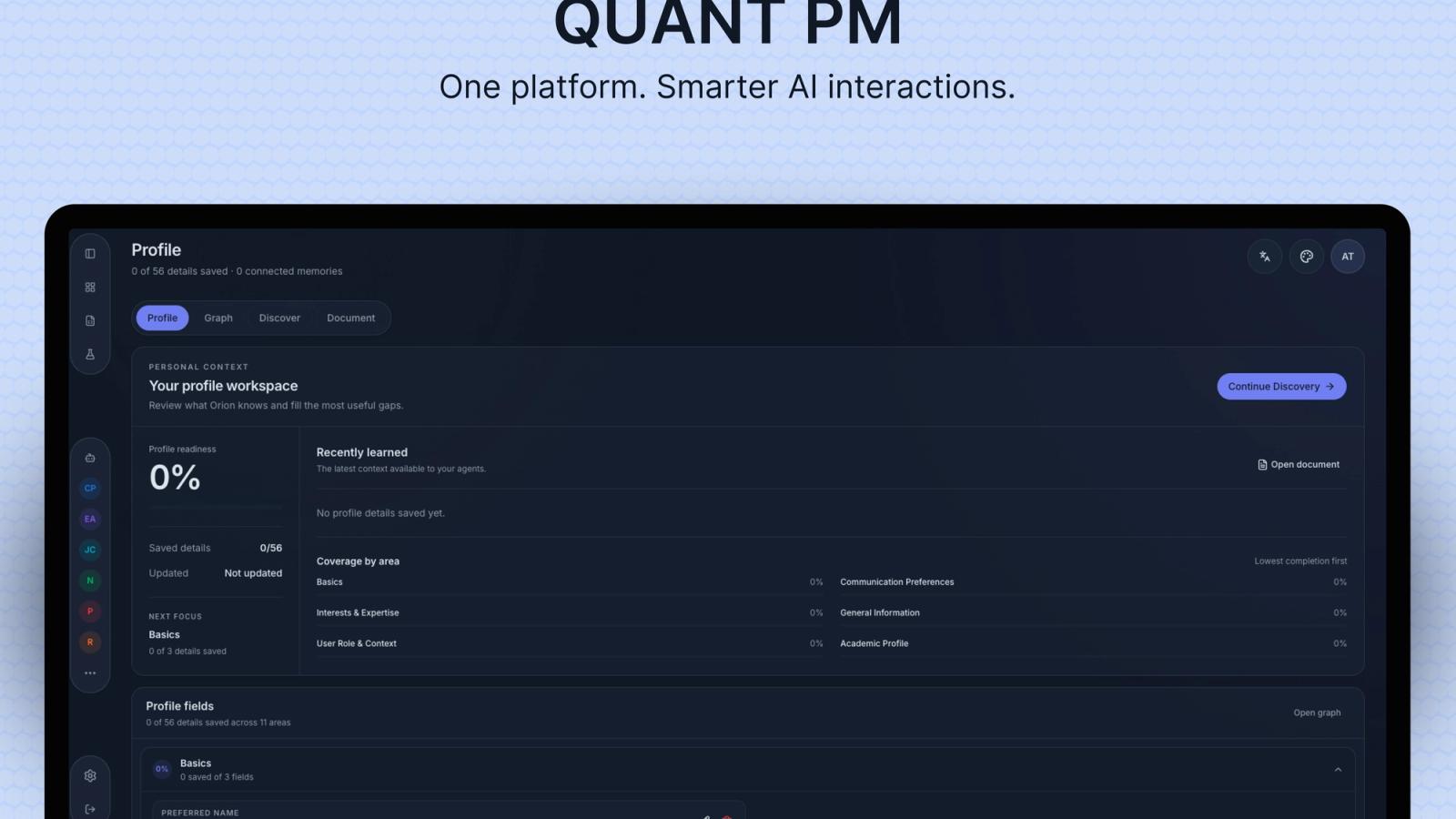
For Quant PM, we shaped one workspace around profile readiness, saved details, coverage by area, connected context, and discovery. The point was not to make users enter more information. It was to show which information could support the next action and keep that process readable in everyday use. Read the case study.
Frequently Asked Questions
What is an AI profile workspace?
It is a product surface that organizes durable facts, supporting documents, relationships, and activity around a person, account, or entity. It gives both users and AI features a shared, reviewable source of context rather than relying on a long chat transcript.
How do you stop AI context from becoming stale?
Make the source and last meaningful change visible, separate durable records from temporary notes, and give users a small correction path. Staleness is easier to manage when the product shows what it used instead of treating every retrieved item as equally reliable.
When should a team build a dedicated workspace instead of using chat?
Use general chat for exploratory work. Build a dedicated workspace when people repeatedly need the same structured records, documents, permissions, and decisions. The workspace is valuable when the context needs to outlive an individual conversation.