Custom SaaS Development

Quant PM – Profile and Context Workspace

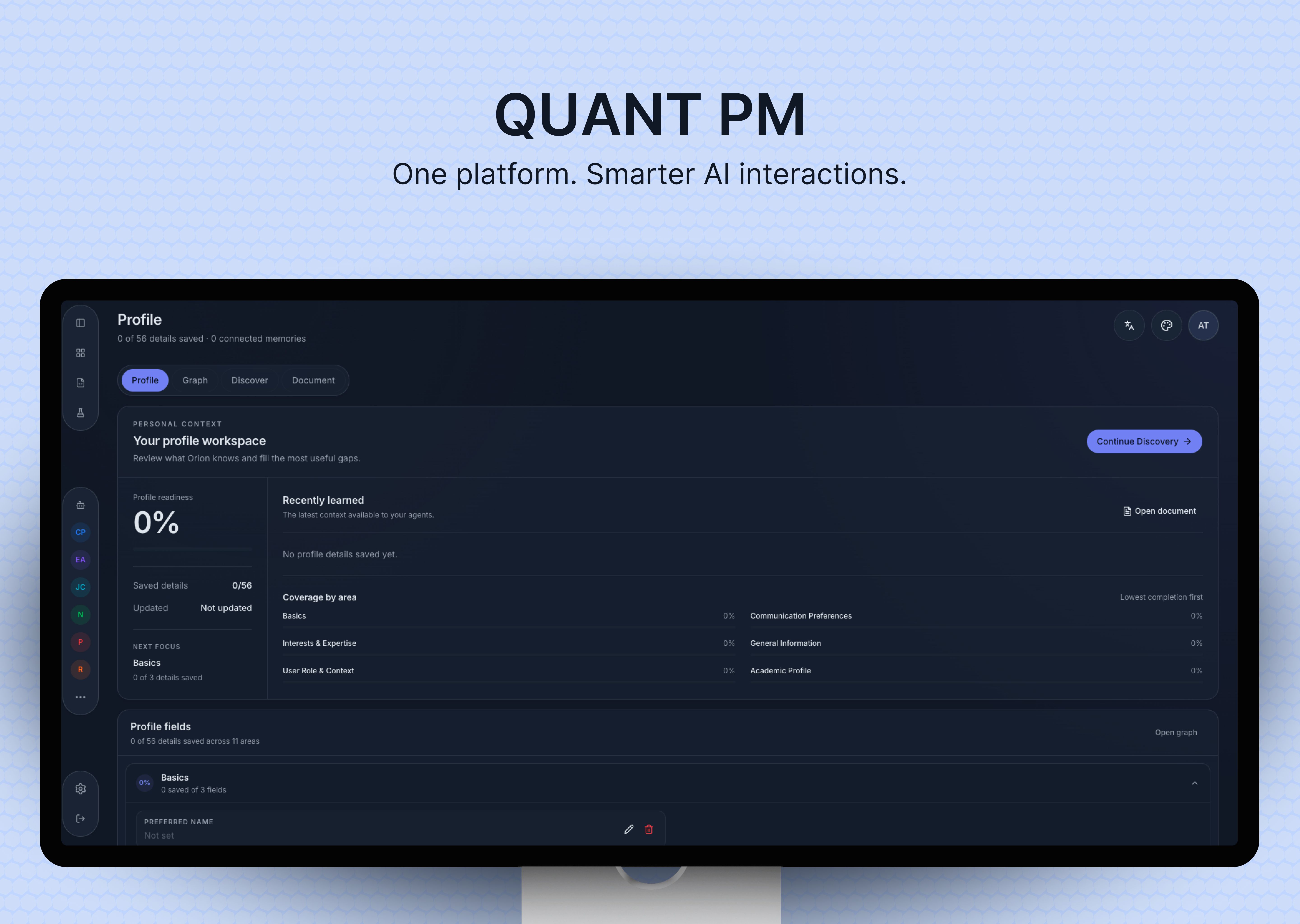
A profile and context workspace built for people who need a usable view of structured details, connected records, and the next useful action. The product brings readiness, saved information, coverage by area, discovery, and context into one operational surface. It makes context inspectable before an AI-assisted interaction depends on it.

Industry

Technology and gaming

Technologies

No tech stack available
Profile and context workspace with structured details and discovery

Quant PM is a profile and context workspace designed around a simple product problem: useful AI interactions require information people can inspect, improve, and apply. We brought profile readiness, saved details, coverage by area, connected context, and discovery into one readable workspace so users could move from an incomplete record to a clear next action.

Who This Is Built For

  • Teams building products around rich profiles and connected information
  • Users who need to understand what is known before they take an action
  • Product owners adding AI-assisted discovery without hiding the underlying context
  • Operations that need a shared record instead of a chain of disconnected screens

The Challenge

Profile-heavy products become difficult to use when details, connected memories, discovery, and documents are separated into unrelated surfaces. People have to reconstruct the picture each time they return. An AI feature layered on top of that fragmentation can sound helpful while still working from incomplete or opaque context.

The Product Direction

We treated the workspace as the product's context model, not as a dashboard of disconnected widgets. Profile readiness showed what was present and what needed attention. Saved details and coverage by area made structured information easy to scan. Connected context and discovery turned related records into useful next actions rather than an archive.

Why a Visible Context Model Matters

Almost every AI product starts with a conversational surface. For lightweight exploration, that is often right. This product needed the opposite emphasis: users had to see the record behind an interaction and decide whether it was complete enough to use.

The trade-off is deliberate. A visible workspace takes more product design than a blank input field. It asks the team to define which records matter, keep them current, and make the information understandable without an assistant summarizing it. Choose a dedicated workspace when the context is reused across ongoing work; choose general chat when the question is temporary.

The Result

The resulting experience gives users a structured way to build context over time while keeping the interface readable enough for everyday use. Instead of making people navigate separate surfaces for details, documents, discovery, and progress, the workspace makes the current state and the next useful action visible in one place.
Outcomes

5

connected workspace surfaces: readiness, saved details, coverage, context, and discovery

1

shared view for structured profiles and related records

2

interaction modes supported: review existing context and take the next action

0

need to treat a chat history as the only source of product context

Project enquiry and resources

Start a Project

Project Resources

FAQ

Frequently asked questions

What is a profile and context workspace?

It is a product surface that groups a profile with the records, documents, relationships, and activity that make the profile useful. It gives people a reviewable place to understand context before they search, decide, or use an AI-assisted feature.

Why not keep AI context inside chat history?

Chat is useful for a temporary task, but it is a poor system of record. Important information becomes hard to find, its source is unclear, and another user cannot tell what is current. A workspace keeps durable context visible and editable.

How should an AI workspace show missing context?

Show the missing field, unsupported area, or unresolved relationship directly in the product and offer a clear next action. A visible gap is more useful than an unexplained confidence score because the person can decide whether the missing information matters.

When does a business need a custom AI workspace?

A custom workspace is useful when the same structured records and permission rules must support repeated work across different people. For a one-off question, general chat may be enough. For an operational workflow, the context needs a durable home.

Selected case studies

Products built around real constraints

Explore Stacknyu case studies across security, HR, insurance, travel, media, communities, fitness, and advisory software. Each project starts with the operating constraint and makes the next action clearer.

Have a complex workflow?

Let's map the product around it.

Tell us what your team needs to run more clearly.

Start a conversation