Published estimates for physical security information management (PSIM) software commonly range from the low hundreds of thousands of dollars for a single large deployment to seven figures for carrier-scale rollouts across hundreds of sites. For a bank integrating existing alarm, fire, and CCTV hardware across a branch network, rather than buying new hardware, the number depends far more on protocol diversity and branch count than on company size.
Who This Is For
- Banks and NBFCs replacing an outsourced Central Monitoring System with an in-house platform
- Security operations teams managing alarm, fire, and CCTV hardware from more than one vendor
- IT and risk teams evaluating build vs buy vs outsource ahead of an RBI audit cycle
- Anyone comparing custom development against off-the-shelf PSIM software
Why Global PSIM Pricing Doesn't Translate Directly
Most published PSIM cost guides are written by large physical-security integrators serving carrier-scale, multi-country deployments, often bundling hardware, installation, and years of licensing into one headline number. Separately, industry research on custom enterprise software more broadly puts fully custom builds anywhere from roughly $250,000 to over $1,000,000, with an in-house security operations centre running into the millions annually to staff continuously. Neither figure is built around the actual cost driver for a bank: how many different protocols its existing hardware already speaks.
One complication specific to India is worth flagging directly: searching for "PSIM software" mostly returns results for an unrelated power-electronics simulation tool, not physical security software. If you're comparing vendors, search for "unified security monitoring platform" or "central monitoring system software" instead — the results are far more relevant.
What Actually Drives the Cost
- Number of protocols to integrate — SIA DC-09, Contact ID, MQTT, and proprietary protocols each add real engineering, not configuration
- Branch count and rollout sequencing — five pilot branches is a different project from five hundred
- Notification and escalation complexity — a basic SMS alert is a different build from a rules engine routing across 180-plus channels by severity and recipient
- Deployment model — cloud-only is materially cheaper and faster to build than a system that must also run fully on-premise
- Camera integration — RTSP and ONVIF live streaming add a real-time video layer distinct from alarm event handling
Three Ways Banks Typically Approach This
Outsourced Central Monitoring System: hardware and monitoring staff supplied by a third party. Fastest to stand up, but ties you to that vendor's hardware and hands your event data to an outside operator.
Off-the-shelf PSIM software: you own the software licence and typically the monitoring function, but integration of non-standard or older panels is usually a paid professional-services engagement per protocol.
Custom-built platform: highest upfront engineering cost, but the only option that natively fits an existing multi-vendor, multi-protocol branch estate without an ongoing per-integration bill.
The RBI Compliance Angle
RBI's Cyber Security Framework for Banks requires continuous monitoring and a fast incident reporting clock. Whichever approach a bank picks, the deciding factor for compliance is whether monitoring is genuinely continuous and automated, not which of the three ownership models it sits under. We cover the specific reporting timeline and what auditors look for separately.
Case in Point
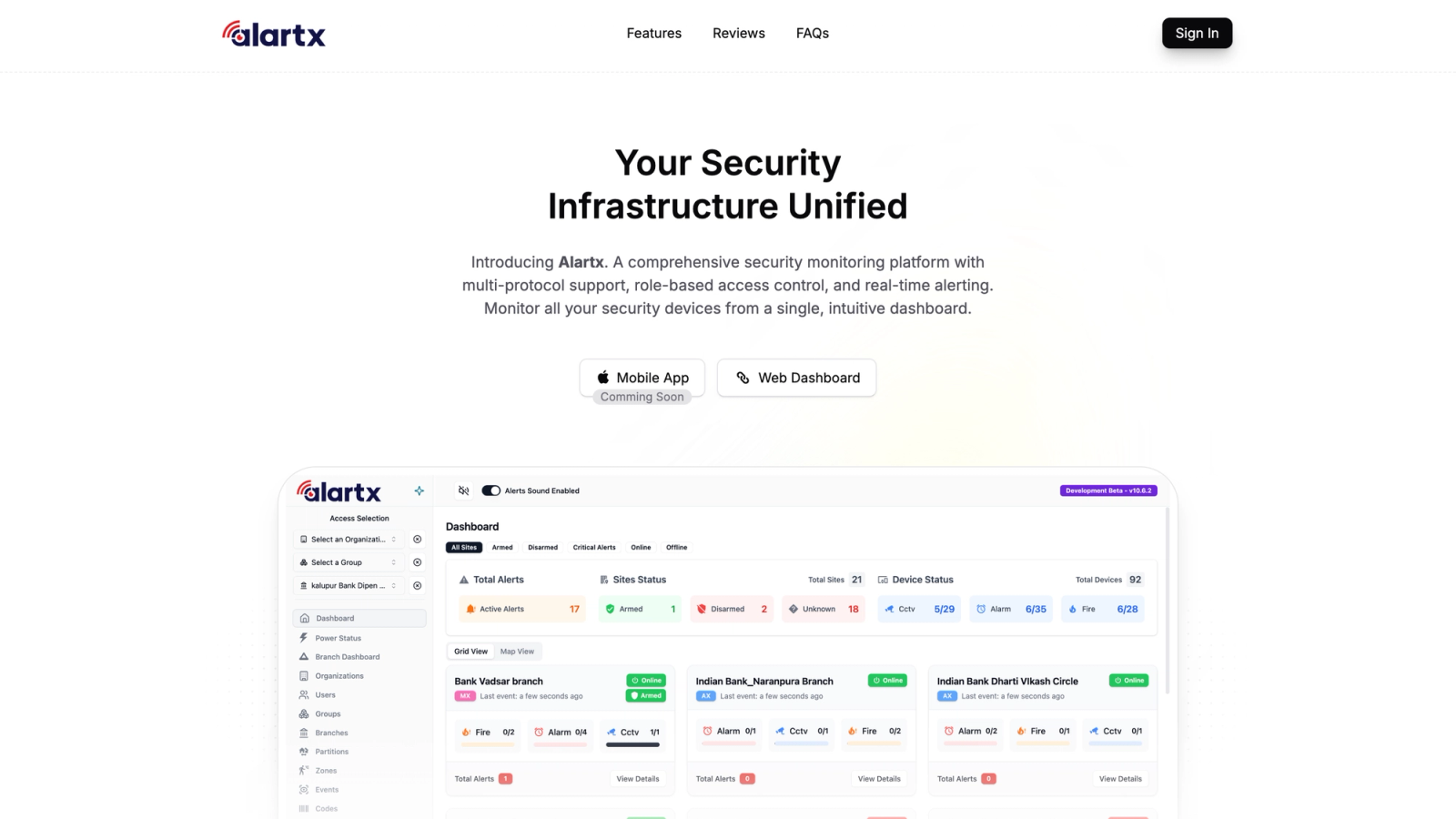
We built Alartx for banks managing security across nationwide branch networks with alarm and camera hardware from multiple vendors installed over more than a decade. Rather than standardising on one vendor's hardware, the platform integrates over SIA DC-09, Contact ID, MQTT, and custom protocols, with an omni-channel notification engine covering more than 180 delivery channels, and deploys as a managed cloud service or fully on-premise.
Frequently Asked Questions
How much does it cost to build a custom security monitoring platform for a bank?
It depends far more on how many protocols and branches you're integrating than on company size. A pilot rollout across a handful of branches with one or two alarm protocols is a materially smaller project than a nationwide rollout integrating five or six protocol types plus live camera streaming. We scope every security integration project individually rather than quoting from a fixed price list.
Is it cheaper to buy an off-the-shelf PSIM platform than to build one?
Often yes for a single-vendor, single-site deployment. It gets more expensive as your hardware estate diversifies, because most off-the-shelf platforms charge per integration or per protocol, and professional services costs stack up fast across a large branch network.
What's the difference between an outsourced Central Monitoring System and an in-house platform?
A CMS is a monitoring service — you hand alerts to a third party who verifies and escalates them. An in-house platform keeps that function inside the bank's own operations team, running on hardware the bank already owns.
Does building custom software mean replacing existing alarm and camera hardware?
Not necessarily. If the platform is built to speak the hardware's existing protocols, panels and cameras already installed can stay in place. Replacement only becomes necessary when the hardware itself is failing or unsupported.