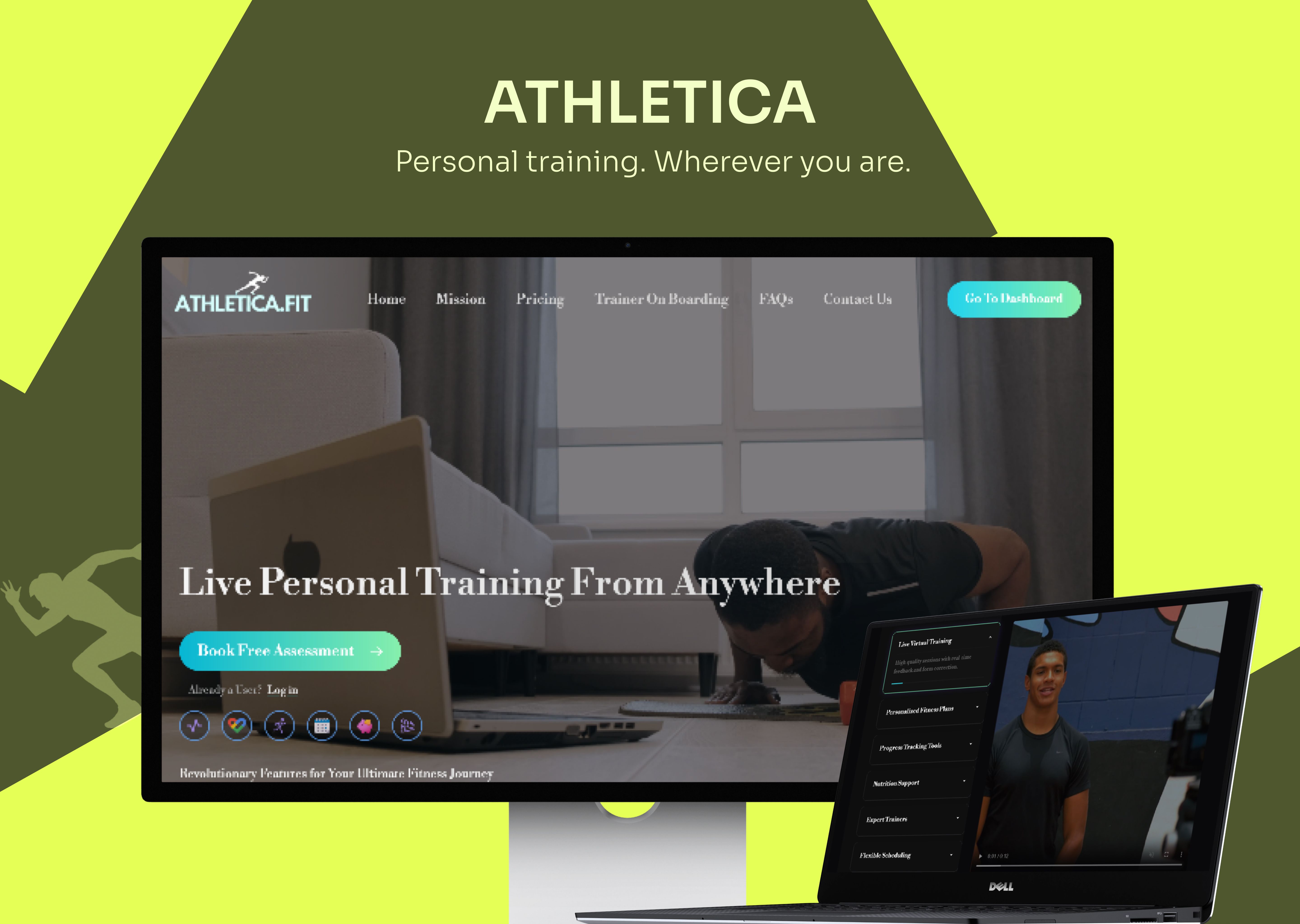
This personal-training platform connects the work before, during, and after a live coaching session. Members can set preferences, complete checkout, access scheduled virtual training, and use a dashboard for workouts, progress, and nutrition. Stacknyu connected that member journey to trainer scheduling and calendar-based session creation so the platform supports an ongoing coaching service, not just a one-time booking.
Who This Is Built For
- Fitness businesses offering live or hybrid coaching programs.
- Trainer networks coordinating member preferences, schedules, and progress.
- Members who need one place for sessions, workouts, progress, and nutrition.
Project Overview
Athletica is a live personal-training platform that brings certified trainers to users anywhere. Members sign up in seconds, set their preferred training times and intensity, and train in live virtual sessions with real-time feedback and form correction. Stacknyu delivered the complete experience — from onboarding and secure checkout to a personalised dashboard for tracking workouts, progress and nutrition — on a modern SvelteKit, PocketBase and Go stack.
Challenges & Objectives
- Friction-Free Onboarding
- Challenge: Signing up for an online fitness platform should not require lengthy forms or a desktop-only flow.
- Objective: Enable quick sign-up with email, phone or social login, followed by simple preference-setting for training times and workout intensity.
- Secure and Transparent Payments
- Challenge: Subscriptions involve recurring plans and add-ons, and users need to trust the payment flow.
- Objective: Build a secure checkout supporting cards, UPI and wallets with 256-bit encryption, clear pricing, a refund policy and cancel-anytime flexibility.
- Progress Tracking That Motivates
- Challenge: Users need more than video calls to stay engaged; they need to see their progress.
- Objective: Create a dashboard with workout history, visual progress analytics, an interactive calendar and profile metrics such as weight, height and age.
Our Approach
- Modern SvelteKit Frontend
- We built the platform with SvelteKit, keeping the interface fast and responsive across devices, with Tailwind CSS for a polished, consistent design system.
- PocketBase and Go Backend
- PocketBase, built on Go, powers authentication, user data and subscriptions, while a Node server acts as the scheduling API — creating Google Calendar events with Meet links for live training sessions.
- Payments and Subscriptions
- We built secure card, UPI and wallet checkout on PayPal's billing engine, then structured the business around transparent subscription tiers and a-la-carte add-ons such as progress assessments, yoga and recovery sessions, plus a clear refund policy and cancel-anytime flexibility.
- Performance-First Deployment
- The platform is deployed on Cloudflare Pages with a serverless-friendly architecture for reliable global performance.
Technologies Used
- Frontend: SvelteKit, TypeScript and Tailwind CSS for a fast, responsive member experience.
- Backend: PocketBase (Go) for data, auth and subscriptions, with a Node server for the Google Calendar scheduling API.
- Payments: Secure PayPal-backed checkout for card, UPI and wallet payments with 256-bit encryption.
- Deployment: Cloudflare Pages for global, low-latency delivery.
Outcome
Athletica launched as an end-to-end personal-training platform where members can discover certified trainers, choose flexible plans — from starter sessions to premium coaching — and track their journey through a personalised dashboard. The result is a smooth, motivating fitness experience that works from anywhere, and a foundation the business can extend with new trainers, plans and features.
Why Scheduling, Coaching, and Progress Needed One Workflow
A standard booking product is a sensible choice when a trainer only needs appointments and payment links. This platform had a deeper service flow: member preferences lead into training, session scheduling creates calendar-based access, and the member dashboard carries coaching context forward between sessions. That creates trade-offs. The team must own calendar failures, subscription rules, privacy boundaries, and the support burden of a custom experience. Use a standard tool when its model fits; build this kind of product when the coaching workflow itself is the service advantage.
Related Reading
How to Build an Online Personal Training Platform
Live Fitness Coaching App Development: Sessions, Schedules, and Subscriptions