An audio-first social app should make speaking easier than typing for a specific community moment. The useful product is not a generic live-room clone. It gives people a reason to discover a conversation, record a short response, join a relevant group, or start a one-to-one exchange. The hard work is connecting the audio experience to onboarding, discovery, permissions, and safety from the first release.
Who This Is For
- Founders building a community product where voice is more natural than a text feed.
- Teams creating interest-led or locality-aware social experiences.
- Product leaders adding recorded posts, group audio, or one-to-one voice to an existing app.
- Mobile teams deciding what to own in the app and what to use from real-time communication infrastructure.
Start with the moment voice improves
Voice has higher effort than a like and lower searchability than text. It earns its place when tone, speed, personality, or conversational turn-taking changes the value of the exchange. A local question, a shared-interest debate, a quick introduction, or a private follow-up can make sense in audio. A product update, searchable reference, or formal announcement may work better as text. The product should allow the right format instead of forcing voice everywhere.
Build four connected experiences
First, onboarding must collect the signal that makes discovery relevant: interests, community preference, and consent for any location-aware feature. Second, the discovery feed must give people a fast reason to listen, not an empty screen after sign-up. Third, recording and playback need to feel reliable under ordinary mobile conditions. Fourth, group and one-to-one conversations need clear participation rules, reporting, and exit paths.
Those four experiences are connected. A polished recording tool cannot rescue a feed with no relevant people. A good feed cannot compensate for a confusing permission model. A fast group room still fails if members do not know who can invite, moderate, or report.
Treat real-time audio as an engineering constraint
Live voice needs a capture, encode, transport, buffer, and playback path that behaves predictably on mobile networks. The best experience is not literally zero latency. It is stable enough that people can take turns naturally. Real-time media infrastructure, codec choices, regional routing, connection recovery, and observability all affect whether a group conversation feels social or frustrating.
Do not overbuild this layer prematurely. A managed communication service can be a sensible choice when the product's differentiation is community design rather than media infrastructure. Build more of the stack only when control, scale, cost structure, or unique interaction requirements make that ownership worthwhile.
Case in Point
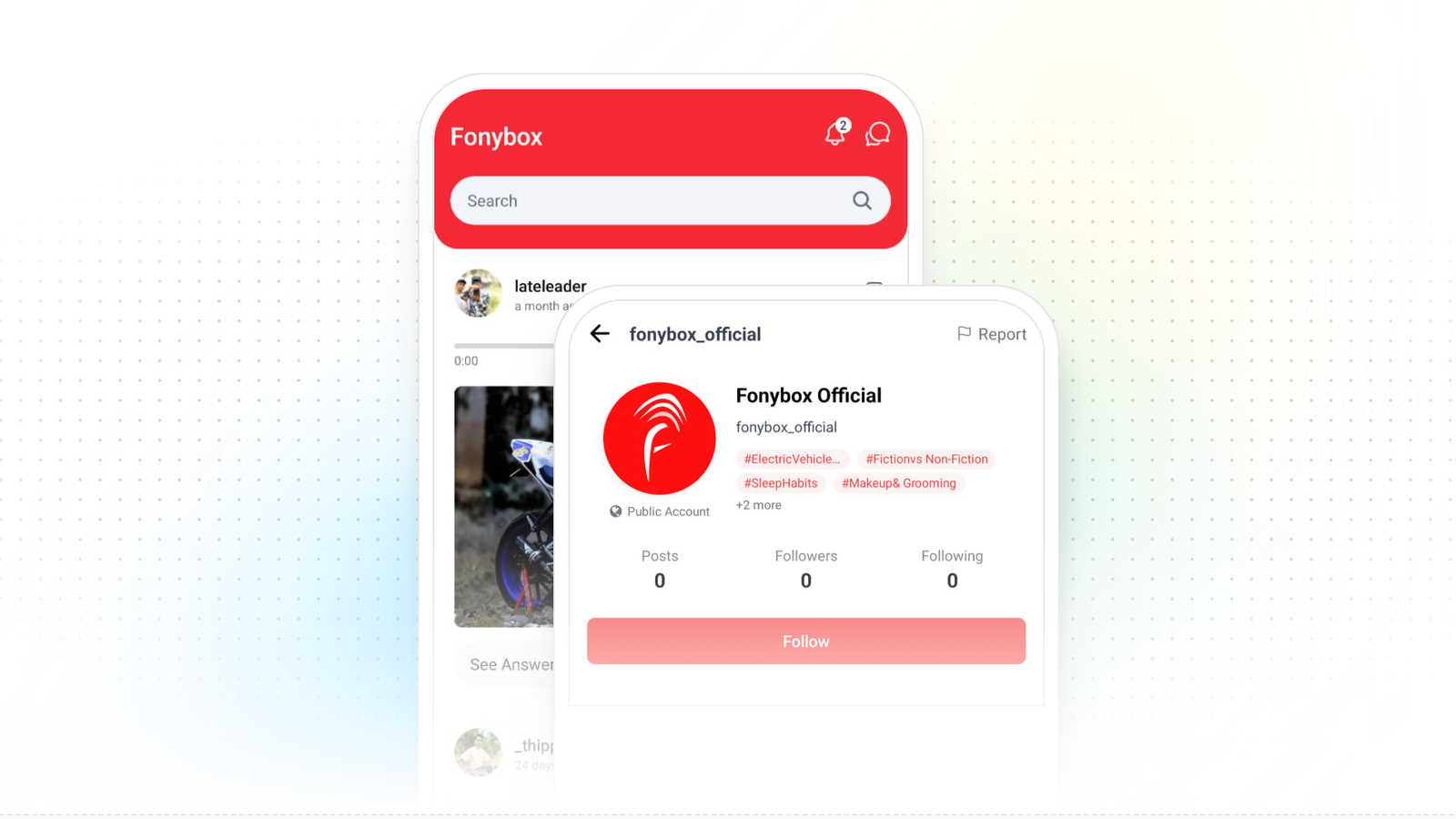
Stacknyu's published Fonybox case study shows an Android community app designed around interest selection, locality-aware feeds, audio-centred posts, public and private group chats, and one-to-one audio conversations. The build used Expo React Native with PocketBase for a practical mobile and real-time foundation. The important lesson is the feature combination: discovery gives voice a reason to exist.
Frequently Asked Questions
What makes an app audio-first rather than a chat app with voice notes?
Audio-first means voice shapes discovery, creation, and interaction. People find conversations through spoken posts, groups, rooms, or profiles, and the product gives recording and listening a primary role. Voice notes alone are usually a messaging feature, not the organising principle of the community.
Should a new social app build its own voice infrastructure?
Usually not at the first release. Use managed infrastructure when the team needs reliable rooms, calls, moderation controls, and mobile support quickly. Consider owning more of the media layer when it is central to the product advantage or when scale and control justify the operational cost.
Related Reading
Interest-Based Community App Development: Discovery Beyond the Feed
Local Voice Community Apps: Privacy, Moderation, and Group Safety