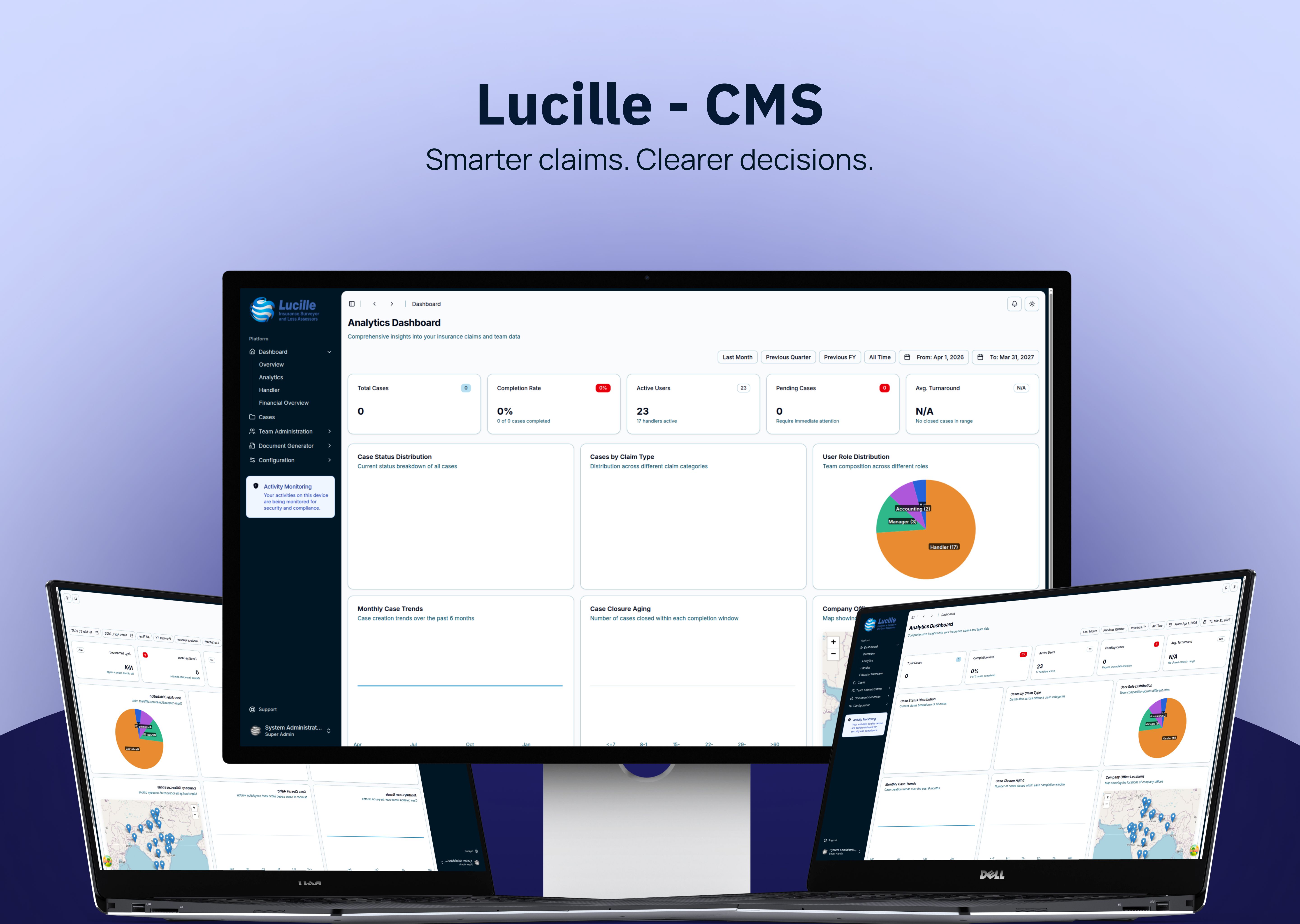
Most claims software is built for insurance carriers, not for the firms that survey and assess claims on their behalf. Surveyor and loss-assessor firms have a different problem: they handle claims for multiple insurers at once, each with its own claim types, statuses and deadlines, often without the option of putting case data in the cloud. Here's what that kind of system actually needs to do.
Why Generic Claims Platforms Don't Fit
Search for insurance surveyor software and most results are field tools — apps for capturing photos, generating valuation reports and calculating depreciation on a single claim. Those are genuinely useful for the field side of the job. But they solve a different problem from back-office case management: tracking a claim through its full lifecycle, across multiple insurers, with the right person able to see the right information at the right stage.
Carrier-scale claims platforms solve the opposite problem — they assume one organisation, one set of claim types, one internal workflow. A surveyor firm works for several insurers simultaneously, and every insurer brings its own format.
The Multi-Insurer Problem
Surveyors are typically licensed across a defined set of risk categories — commonly including fire, motor, engineering, marine cargo, marine hull, loss of profit, and miscellaneous risks — and a firm handling several of these for multiple insurers ends up managing claim types that don't share a single structure. Fields that matter for a fire claim don't apply to a motor claim. Deadlines that one insurer enforces don't apply to another. A system built around one fixed claim form breaks the first time it meets a second insurer's format.
The fix isn't more fields — it's configurable master data: claim types, offices, insurers, financial years and deadlines that a Super Admin can define and adjust without a developer, so the system flexes to match how the firm actually works rather than forcing the firm to adapt to the software.
What a Surveyor Firm's System Actually Needs
- Configurable claim types and fields, per insurer — not one fixed form for every claim
- Role-based dashboards for handlers, managers and back-office accounting staff
- Automatic, collision-free case referencing across offices and financial years
- A full audit trail for every status change and document
- The option to run entirely inside the firm's own network, if client data can't go to the cloud
- A realistic migration path from whatever the firm is using today — usually spreadsheets
From Spreadsheets to a Real System
Most surveyor and loss-assessor firms run on spreadsheets for longer than makes sense, because the alternative looks like either an expensive carrier platform that doesn't fit, or a risky rebuild of years of case history. Spreadsheets work until they don't: multiple people editing the same file, no real audit trail, no way to enforce that a claim reference is actually unique, and no dashboard view of what's actually outstanding.
The migration itself is usually the part firms worry about most — and it's solvable. A structured migration maps every historical record into the new system's reference scheme, preserves original dates and statuses, and validates the count before and after so nothing is silently dropped.
Case in Point
We built exactly this kind of system for an insurance surveyor firm: four role-based dashboards, claim types and master data configurable without a developer, and more than 15,000 historical claims migrated in from 2016 with zero data loss — all running inside the firm's own office network.
Frequently Asked Questions
What's the difference between survey software and claims management software?
Survey software — field inspection, photo capture, valuation reports — helps a surveyor complete a single assessment. Claims management software tracks a case through its entire lifecycle across a firm: intake, assignment, status, documents and closure, often across many claims and several insurers at once. Most firms eventually need both, from different tools.
Can one system handle claim types that differ by insurer?
Yes, if it's built around configurable master data rather than a fixed form. Claim types, required fields and deadlines should be something an admin can define per insurer, not something baked into the code.
How do you migrate years of claims history without losing records?
By mapping every historical field into the new system's structure before migration starts, running the migration in a way that's verifiable record-by-record, and checking totals before and after. It's a project in its own right, not a checkbox.
Does this kind of system have to be cloud-hosted?
No. When claims data can't leave the firm's own network, it can be built as a desktop application that checks the device is on an authorised network before it opens, instead of a hosted web portal.