Published estimates for enterprise claims management platforms commonly range from roughly $40,000 to $400,000 or more — but that range is built around carrier-scale requirements. A focused system for a surveyor firm, TPA, or mid-size claims operation, covering case intake, role-based workflows, document generation and reporting, sits well below that ceiling. Scope is what actually moves the number, not company size or geography.
Who This Is For
- Insurance surveyor and loss-assessor firms replacing spreadsheets with a real system
- Third-party administrators handling claims across multiple insurers
- In-house claims departments outgrowing manual tracking
- Anyone comparing a custom build against an off-the-shelf claims platform
Why Published Cost Ranges Don't Fit Most Buyers
Most published cost guides for claims management software are written for insurance carriers — companies processing thousands of claims a month across multiple lines of business, integrating with policy administration systems, and building in AI-driven fraud detection or automated adjudication. That's a genuinely different project from what a surveyor firm, TPA, or mid-size claims operation actually needs.
A carrier-scale platform has to handle intake from multiple channels, integrate with a policy administration system, support several lines of business, and often include a rules engine for automated decisioning. A back-office claims system for a surveyor or TPA handles one core job well: taking a claim from intake to closure, with the right people seeing the right information at each stage. That's a smaller, more tightly scoped build — which is exactly why carrier pricing is the wrong benchmark for this budget conversation.
What Actually Drives the Cost
Four things move the number more than anything else:
- Number of user roles — a system with one type of user is a different build from one with four distinct roles, each needing its own dashboard and permission set.
- How much claim types vary — if every insurer, office and claim type needs its own fields and statuses, the case engine has to be built to flex, which is real engineering rather than configuration.
- Historical data migration — carrying years of existing case history into the new system, without renumbering or losing records, is its own project inside the project.
- Deployment model — a system that has to run inside your own network, rather than as a hosted web app, changes the architecture from day one.
A Three-Tier Way to Think About Scope
Rather than a single price, it's more useful to think in three tiers of scope.
- Essential — a single or two-role system: case intake, status tracking and basic reporting. Good for a small firm digitizing a spreadsheet-based process for the first time.
- Operational — multi-role workflows, automatic reference numbering, document generation and a full audit trail. This is where most surveyor firms and TPAs actually land.
- Enterprise — everything in Operational plus integrations with external systems, advanced analytics, and support for a large, distributed team. This tier starts to approach carrier-scale requirements and carrier-scale cost.
Build vs Buy, Honestly
Buying an off-the-shelf platform is usually the right call when your claim types are standard, your workflow can adapt to the vendor's, and per-user licensing across your team costs less than owning a system outright.
Building makes sense when your claim lifecycle genuinely differs by insurer, office or financial year, when the system needs to run inside your own network rather than a vendor's cloud, or when you're carrying years of historical data that an off-the-shelf platform can't model the way your firm actually works.
Case in Point
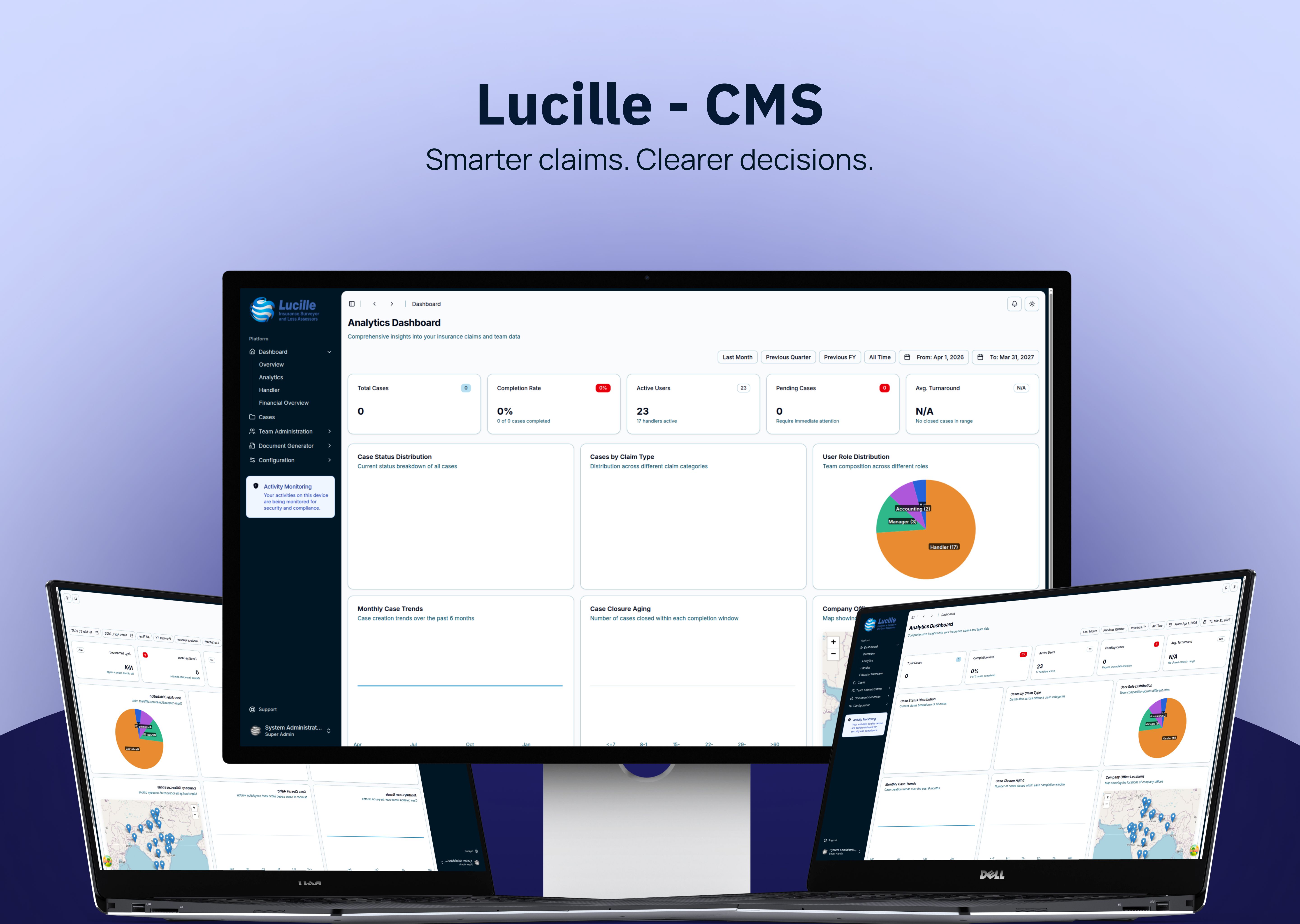
We built a claims management system for an insurance surveyor firm that needed exactly this: four role-based dashboards, automatic case referencing and a full audit trail, running inside the firm's own network, with more than 15,000 historical claims migrated in from 2016 onward.
Frequently Asked Questions
How much does a custom claims management system cost?
It depends more on scope than on company size — the number of roles, claim types and integrations you need on day one is what moves the estimate, far more than which insurer or region you're in. We scope every claims project individually rather than quoting from a fixed price list.
Is it cheaper to buy claims software than to build it?
Usually, if your workflow is standard. Off-the-shelf platforms spread their cost across many customers, but per-user pricing adds up over a large team, and a workflow that doesn't fit forces expensive workarounds. The real comparison is total cost of ownership over several years, not the sticker price on day one.
How long does it take to build a custom claims management system?
A focused, single-organisation system at the Operational tier typically takes a few months from scoping to launch. Timelines extend with the number of roles, the complexity of claim-type variation, and how much historical data needs to be migrated.
Can a claims system be built to run without cloud hosting?
Yes. When data can't leave an organisation's own network, the right architecture is a desktop application that verifies the device is on an authorised network before it will even open, rather than a cloud-hosted web portal.