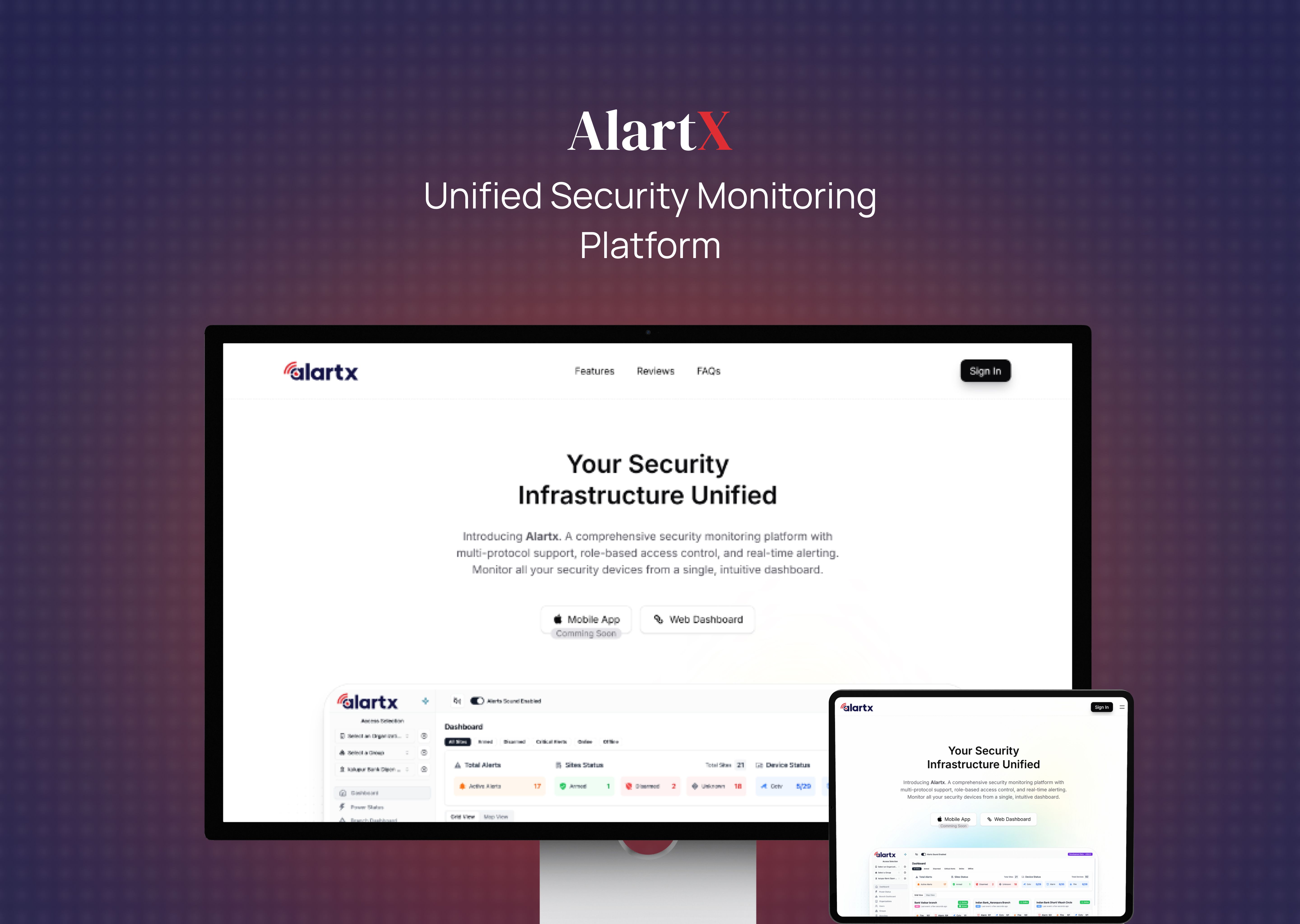
Alartx is a unified security operations platform that gives banks with mixed alarm and camera hardware across hundreds of branches a single real-time dashboard. It connects directly over SIA DC-09, Contact ID, MQTT, and custom protocols — so branches keep the panels they already have. An omni-channel engine routes alerts through more than 180 channels, and the platform runs as a managed cloud service or fully on-premise.
Who This Is Built For
- Banks and financial institutions managing security across a nationwide branch network
- Security operations teams replacing an outsourced Central Monitoring System with software they run themselves
- Institutions with alarm, fire, or CCTV hardware from more than one vendor
- Organisations that need data residency options — cloud for most deployments, on-premise where required
Alartx – Unified Security Infrastructure for Enterprise-Scale Institutions
Project Overview
Large banks often grow branch by branch, city by city, until their security infrastructure becomes a patchwork of devices, vendors, and legacy systems. Intrusion panels in one region, fire alarms from another supplier, CCTV streams in varying formats — all operating, but rarely together.
Our team set out to build a platform that could bring coherence to this landscape. Alartx became that platform: a unified security management system capable of integrating multi-protocol devices, monitoring thousands of endpoints, and offering a single, real-time view of an organisation’s security posture.
Today, it is used by leading banks across India to manage the security of their nationwide branch networks.
What challenge were we trying to solve?
How do you create one calm, reliable command centre from hundreds of disconnected systems?
This question shaped every design decision. Banks needed:
- A single dashboard for all locations
- Real-time visibility into alarms, device health, and incidents
- Support for legacy and modern devices across multiple protocols
- A role structure that mirrors the organisation’s real hierarchy
- A platform that could scale without breaking
The answer required more than software—it required rethinking how institutions “listen” to their security infrastructure.
How did we approach the solution?
We focused on building a system that feels unified even when the underlying devices are not.
1. Multi-protocol Device Integration
We designed the platform to speak multiple languages — SIA DC-09, CID, MQTT, and custom protocols — ensuring that nearly any alarm panel, CCTV interface, or monitoring device could connect without replacing existing hardware.
2. Enterprise-wide Monitoring
The dashboard offers:
- Live status across branches and regions
- Health monitoring for every connected device
- Real-time alarms with instant notifications
- Visual maps showing branch-zone conditions
Rather than overwhelming users, the interface was crafted to feel calm even when the data is dense.
3. Role-Based Access Control (RBAC)
Security teams in banks have complex hierarchies. We implemented RBAC so that each level — from a single branch to national command centres — sees what is relevant, nothing more.
4. Deployment at Scale
Our team handled migrations from legacy systems, coordinated device onboarding across regions, and ensured that the platform could grow with each new branch added.
Why Alartx Doesn't Ask Banks to Replace Their Hardware
Almost every guide to unifying bank security concludes the same thing: standardise on one vendor's hardware, then buy that vendor's monitoring platform. For a single new branch, that's often the right call. For a bank with ten or fifteen years of alarm panels, fire systems, and cameras installed branch by branch by different regional contractors, it isn't.
The constraint is real. Swapping every panel across a nationwide branch network means physical site visits, downtime during the changeover, and losing years of institutional knowledge about each branch's quirks along with the old system.
Off-the-shelf central monitoring, the kind offered by hardware-led security vendors, solves this by outsourcing the problem: a bank hands monitoring to a third party that supplies and owns the hardware. That works, but it means standardising on one vendor going forward and giving up in-house visibility into your own security data.
Alartx takes a third path. It speaks the protocols the existing hardware already uses — SIA DC-09 and Contact ID for alarm panels, MQTT for newer IoT-connected devices, and custom protocol adapters for anything that fits neither — and translates all of it into one event stream. A branch's fifteen-year-old alarm panel and last month's IP camera end up in the same dashboard, the same alert rules, and the same audit trail.
This approach has real costs, and they're worth stating plainly:
- Protocol translation is a layer that has to be maintained as hardware vendors deprecate or change firmware — it's not a one-time integration.
- A platform this flexible has more configuration surface than a single-vendor system, so onboarding a new branch takes longer than plugging in a matching panel.
- It doesn't remove the case for hardware replacement entirely — a panel that's actually failing, or one with no vendor support left at all, is still better replaced than integrated.
Choose integration when the hardware works and the cost is in coordination, not the equipment. Choose replacement when the panel itself is what's broken.
Key Capabilities
- Unified dashboard across all branches
- Multi-protocol device support
- Real-time alerts and notifications
- Zone- and region-based hierarchies
- User and role management reflecting real organisational structure
- Detailed reporting and audit trails
- Visual geography-based monitoring
- API integrations for extended workflows
Impact for Clients
Banks using Alartx route every alert — from a fire panel in one branch to a CCTV motion trigger in another — through a single dashboard and an omni-channel notification engine covering more than 180 delivery channels. Instead of juggling systems from different vendors and eras, teams work from one consistent source of truth, with the option to keep every byte of that data inside their own network.
Some quiet but meaningful outcomes include:
- A smoother daily workflow for security operations teams
- Fewer missed device failures or silent alarms
- Predictable expansion as new branches come online
- Better coordination between branch, regional, and headquarters teams
The platform doesn’t just show what is happening — it helps institutions understand their security ecosystem as a whole.
A reflective insight
When many systems finally speak through one interface, something interesting happens:
Incidents become patterns, patterns become insights, and insights become decisions.
Alartx was built to enable that transition — from reaction to understanding.