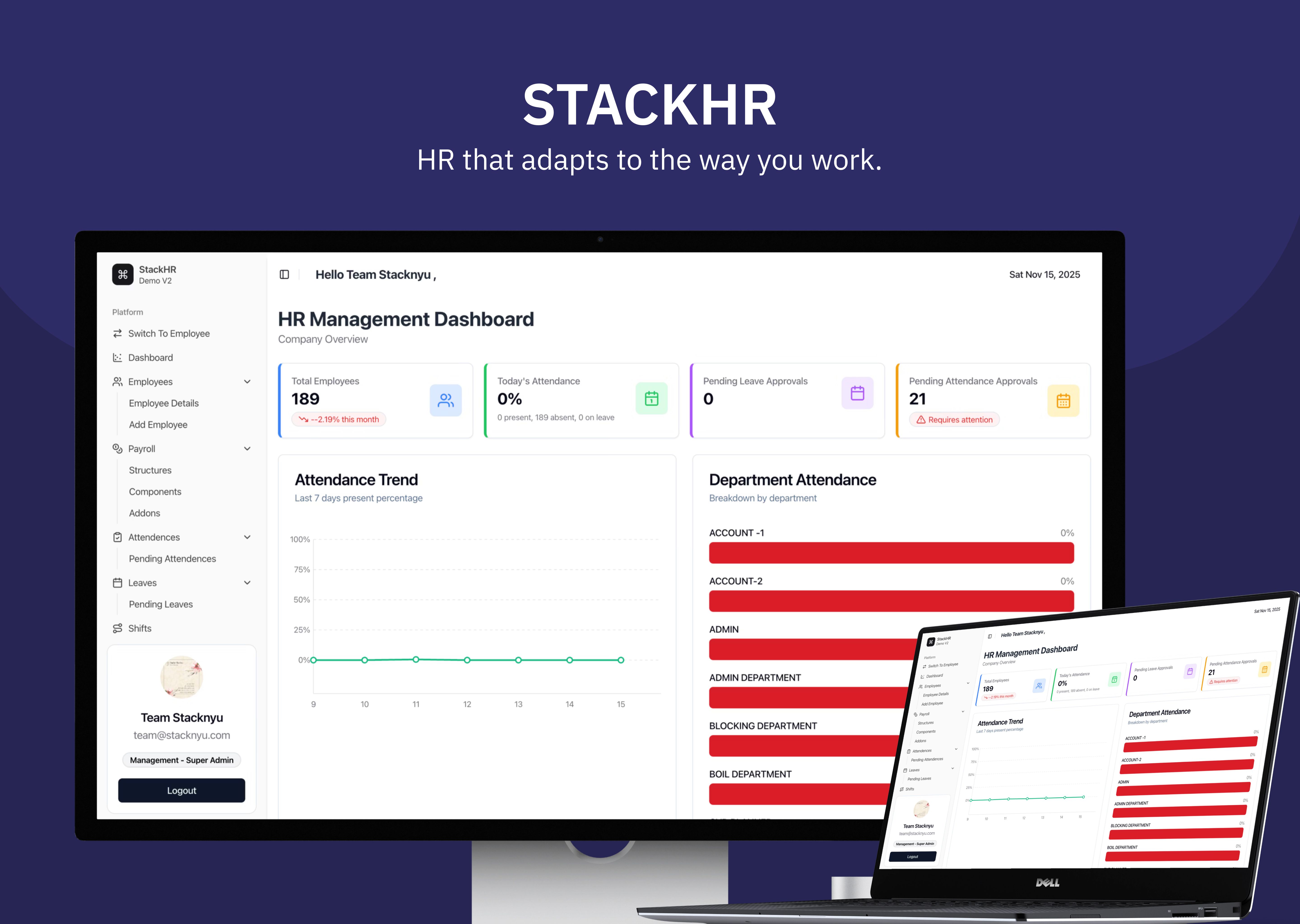
StackHR is a configurable HR and payroll platform built for organisations where no two branches run the same rules. It currently manages more than 1,000 employees and has processed over ₹10 crore in payroll, with independent configuration for timings, holidays, overtime, and pay structure at branch or category level, plus multi-hierarchical cost-center reporting with cross-center audits.
Who This Is Built For
- Multi-branch organisations where pay rules, shifts, and holidays differ by location or category
- Finance and HR teams managing budgets across a multi-level cost-center hierarchy
- Organisations routing around their HRMS with side spreadsheets because it can't model a specific rule
- Teams that need document expiry tracking built into the same system as payroll
Project Overview
HR operations inside large, multi-branch organisations rarely follow a single rhythm. Teams across locations work with different timings, different pay structures, different holidays, and different rules for overtime or breaks. Traditional HR systems try to simplify this by forcing everyone into one model — and in doing so, often make things harder.
StackHR was built with the opposite philosophy:
let the system adapt to the organisation, not the organisation to the system.
It is a deeply flexible HR management platform designed to handle variations in branches, categories, shifts, payroll logic, and compliance without losing clarity or control.
What challenge were we solving?
Every organisation carries its own internal logic.
A branch might allow a two-hour lunch break.
A field team might follow a rotating shift.
A department might have a unique pay structure or holiday calendar.
And documents, expiry dates, and compliance events move on their own clock.
The challenge was simple to describe but difficult to build:
Could one platform manage all of this without forcing standardisation?
StackHR became the answer.
How did we approach the solution?
1. 100% Customisable Time & Pay Structure
StackHR treats every rule as modular and adjustable:
- Branch-specific office timings
- Custom lunch break durations
- Category-wise holidays
- Different overtime rules for different teams
- Multiple pay structures and formula-driven payroll
- Adjustable salary components
- Group-specific attendance logic
The result is a system that mirrors the organisation’s real-world operations with precision.
2. Deep Payroll Automation
Payroll is more than a calculation — it is a set of relationships between attendance, policy, compliance, timings, and roles. StackHR automates:
- Attendance-linked salary computation
- Role- or branch-based pay variations
- Incentives, allowances, and deductions
- Multi-level approval workflows
- Compliance-related adjustments
- Variable pay structures at any granularity
Automation turns complexity into consistency.
3. Document Management & Auto-Tracking
HR teams spend significant time chasing paperwork. StackHR includes:
- Auto-reminders for expiring documents
- Document templates and generation tools
- Secure storage with versioning
- Branch-wise document assignment
- Policy-based document monitoring
Documents remain in order without manual tracking.
4. Multi-Branch, Multi-Category HR Operations
StackHR is designed for organisations where no two branches function identically.
Every branch can carry its own set of rules:
- Shift patterns
- Holidays
- Approval hierarchies
- Payroll formulas
- Attendance logic
This makes nationwide HR operations feel coherent without eliminating local flexibility.
Why StackHR Doesn't Force One Rule Set Across Every Branch
Most HR software solves organisational variation by picking a winner: one set of shift rules, one holiday calendar, one pay formula, and every branch adapts to it. For a single-location business, that's the right trade-off — simplicity beats flexibility. For an organisation where a factory floor runs three shifts, a sales office runs standard hours, and a field team follows no fixed shift at all, forcing one model breaks down within the first few branches.
The failure mode is quiet, not loud. Off-the-shelf HRMS platforms don't reject a rule they can't model — they simply have no field for it, and HR teams route around the gap in a side spreadsheet. That spreadsheet becomes the real system of record, and the HRMS becomes an incomplete copy of it.
StackHR treats every rule — timings, breaks, holidays, overtime, pay structure, salary components, and attendance logic — as independently configurable per branch or category, not as a global default with exceptions bolted on. The same architecture extends into cost accounting: cost centers sit in a multi-level hierarchy, spend is reported daily rather than surfacing only at month-end, and deficits in one cost center can be reconciled against others with a full audit trail across centers.
This flexibility has real costs, worth stating plainly:
- More configuration means more surface area to test — a new branch with a genuinely unique rule set takes longer to onboard than one that fits an existing template.
- Flexibility only pays off if someone owns the configuration — a system this adjustable can drift into inconsistency without a clear policy owner keeping branch rules deliberate rather than accidental.
- For a single-location business with standard shifts and one pay structure, this is more system than necessary — a standard HRMS subscription is the right call.
Choose a configurable platform when branch-level variation is real and growing. Choose a standard HRMS when your policies are already uniform and likely to stay that way.
Key Capabilities
- Fully customisable HR rules
- Multi-branch and multi-category management
- Advanced payroll automation
- Auto document-expiry monitoring
- Smart document creation
- Configurable shift, overtime, and holiday structures
- Detailed reporting and audit trails
- End-to-end employee lifecycle handling
Impact for Clients
StackHR currently manages more than 1,000 employees and has processed over ₹10 crore in payroll for organisations running branch-specific rules for timings, holidays, overtime, and pay structure. Cost centers are tracked in a multi-level hierarchy with daily reporting, cross-center audits, and deficit reconciliation — giving finance and HR the same real-time visibility that used to live in a dozen separate spreadsheets.
Clients experience:
- Less manual correction
- Fewer payroll discrepancies
- Automated document compliance
- Improved operational clarity
- Smooth scaling across new branches
- Customisation without complexity for HR teams
StackHR becomes a backbone for HR operations rather than another system to manage.
A reflective insight
HR isn’t just about rules — it’s about people, patterns, and the subtle differences in how teams work.
StackHR recognises that the real world isn’t standardised.
Instead of reshaping the organisation to fit the software, it shapes the software to fit the organisation.