Job portal development cost is driven less by the job-listing screen than by the workflow around it. A platform that lets people upload a CV, buy credits, choose employers, distribute documents, track balances and manage delivery needs a different scope from a board that only publishes vacancies. The first release should therefore be priced and planned by workflow modules, not by the number of pages.
Who This Is For
- Founders building a niche job portal with a paid candidate-side service.
- Recruitment businesses that distribute CVs to a defined recruiter network.
- Career platforms that need payment-backed access to outreach or visibility.
- Teams replacing spreadsheets and manual email delivery with a traceable platform.
What Determines Job Portal Development Cost?
A useful scope starts with the buyer journey: account creation, CV upload, credit purchase, recipient selection, delivery, history and support. The platform also needs an operator journey for reviewing users, monitoring transactions, managing the recruiter database and checking distribution activity. Those two sides create the real engineering surface.
The Five Cost Buckets to Scope
- Candidate workspace: registration, CV upload, profile data, credit balance and distribution history.
- Credit and payment layer: packages, checkout, successful payment state, failed payment handling and balance changes.
- Distribution engine: recipient selection, delivery rules, queue behavior, email provider integration and status tracking.
- Administration: user management, credit transactions, delivery monitoring, reporting and system controls.
- Platform foundation: authentication, responsive UI, data storage, deployment, backups and operational visibility.
Why a Credit Model Changes the Build
Credits turn a simple form submission into a ledger. Every purchase needs a reliable transaction record. Every distribution needs a predictable deduction. The interface must show the current balance, while the admin side needs enough history to explain why a balance changed. This is why a credit wallet should be designed as a product capability, not added as a payment button near the end.
How to Scope the First Release
- Define one clear candidate journey before adding employer portals, matching or mobile apps.
- Choose the exact event that consumes a credit and make it visible in the user history.
- Separate payment confirmation from delivery completion so support can diagnose both states.
- Keep the admin panel in the first scope when the product handles money, personal documents or outbound email.
When a Standard Job Board Is Enough
A hosted job-board product is often the better choice when the requirement is limited to publishing listings, collecting applications and sending basic alerts. Custom development becomes easier to justify when the core value is a different workflow, such as candidate-paid CV distribution, a private recruiter network, a credit economy or operator-controlled delivery.
Case in Point
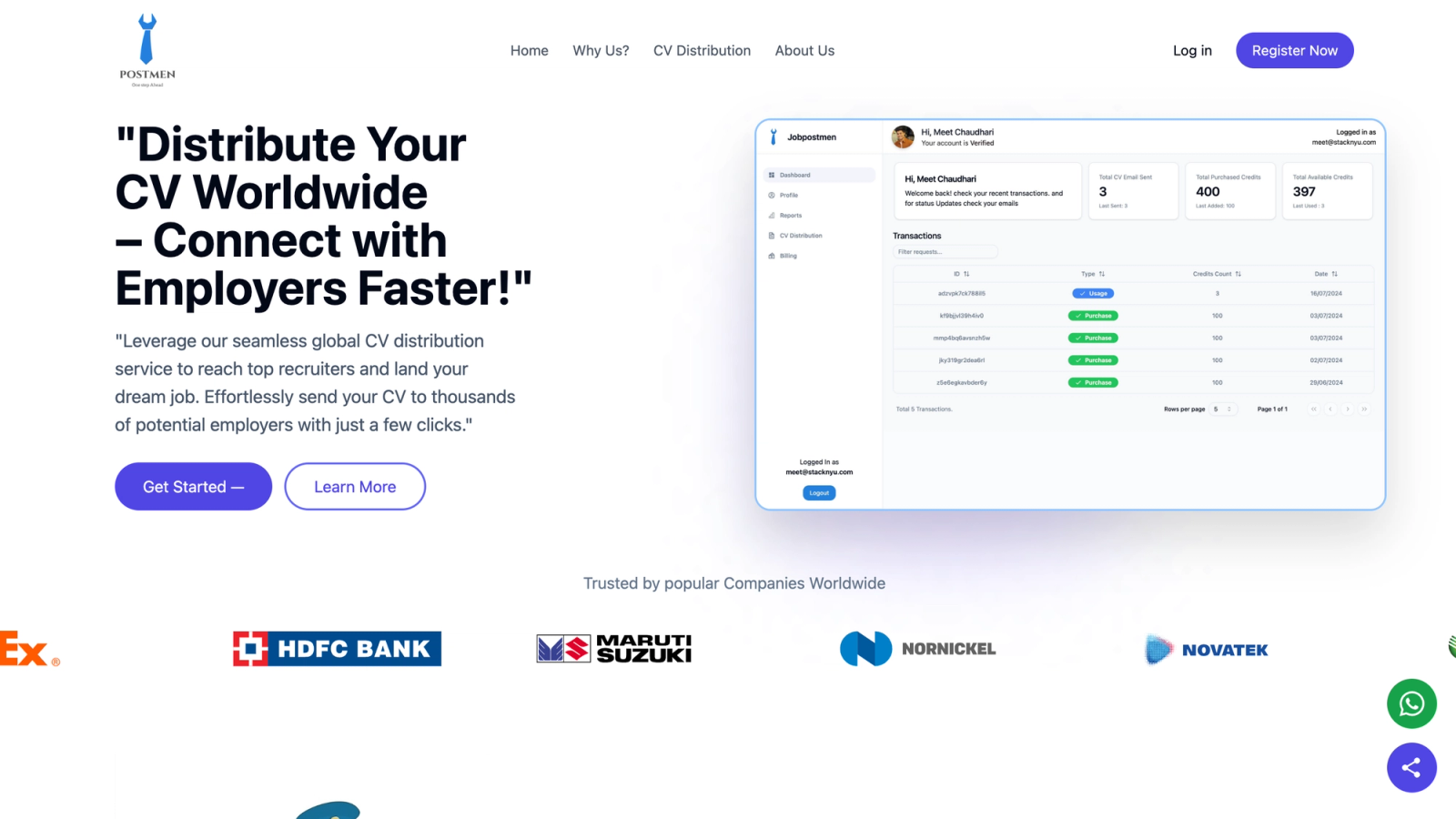
JobPostmen combined CV upload, credit purchases, selected-recipient distribution and administration in one responsive platform. Its stated reach covers more than 2 million recruiters across 195+ countries, 2,000+ cities and 50+ industry categories. Read the JobPostmen case study for the implementation details.
Frequently Asked Questions
How much does it cost to build a custom job portal?
The answer depends on whether the portal only publishes jobs or also handles candidate profiles, payments, credit balances, email delivery, analytics and administration. Define the workflow first, then estimate each module. Do not treat a marketplace-style payment and delivery system as a simple content website.
What features should a paid CV distribution platform include?
The core set is a candidate account, CV upload, credit purchase, recipient selection, delivery status, transaction history, support visibility and an admin panel. Add matching, employer accounts or automation only when the business model requires them.
Should a job portal include an admin dashboard?
Yes when it stores personal documents, accepts payments or sends CVs to third parties. Operators need to review user activity, transactions, balances and delivery states without querying the database manually.