Off-the-shelf HRMS platforms fail quietly, not loudly. They don't reject a pay rule they can't model — they simply have no field for it, and HR teams route around the gap in a spreadsheet. For multi-branch companies, that gap usually shows up first in shift timings, then overtime formulas, then holiday calendars that vary by location or category.
Who This Is For
- HR teams already running a "shadow spreadsheet" alongside their HRMS
- Companies opening new branches with different shift patterns than their existing locations
- Finance teams who need cost-center-level payroll reporting their HRMS doesn't provide
- Anyone evaluating whether their current HRMS has genuinely outgrown their organisation
The Failure Pattern
This is a well-documented pattern in build-vs-buy analysis: one review described an HR tool that couldn't model a phased leave-accrual policy for a four-day work week — not a bug, just a rule the data model had no room for. Multiplied across every payroll exception a company routes into a side spreadsheet instead, that gap is what eventually flips the build-vs-buy decision.
Where Branch Variation Actually Shows Up
- Shift timings and lunch break durations
- Overtime rules that differ by team or category
- Holiday calendars that vary by branch or region
- Pay formulas and salary components that aren't uniform across the organisation
- Attendance logic tied to local policy rather than a company-wide default
The Real Cost of the Workaround
Side spreadsheets become shadow systems of record, reconciliation eats real time every payroll cycle, and error rates climb specifically at the boundary between HRMS data and spreadsheet data — exactly where nobody is double-checking by default. For a genuinely single-policy organisation, none of this applies — the workaround never appears because there's nothing to work around.
What a Rule-Level Configuration Model Looks Like
Each rule — timing, break, holiday, overtime, pay formula — is a first-class configurable object attached to a branch or category, not a global setting with per-branch exceptions layered on top. This is architecturally different from typical "multi-location support" marketing claims, which usually mean the same rules apply everywhere with a location field added for reporting, not genuinely different rules per location.
Case in Point
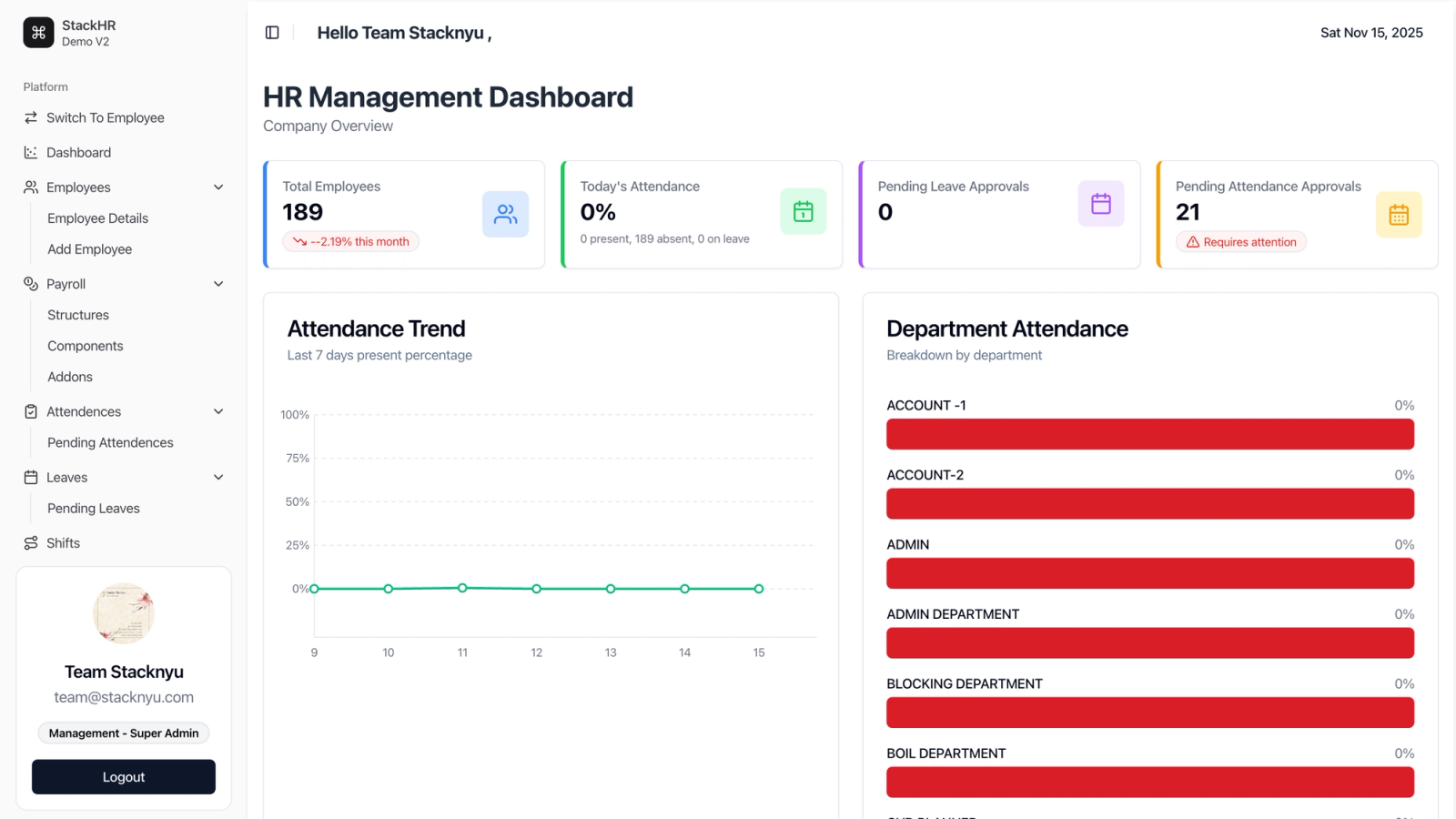
StackHR treats every HR rule — timings, breaks, holidays, overtime, pay structure, and attendance logic — as independently configurable per branch or category. It now manages more than 1,000 employees across branches that don't share a single rule set, without HR needing a side spreadsheet to cover the gaps.
Frequently Asked Questions
How do I know if I've outgrown my HRMS?
The clearest sign is a spreadsheet HR maintains alongside the HRMS to handle a rule the software can't express — a specific overtime formula, a phased leave policy, a branch-specific holiday calendar.
Is this just a "multi-location support" feature?
Not quite. Most HRMS platforms' multi-location support means the same rules apply everywhere with a location tag for reporting. Genuine branch-level configuration means each branch can have entirely different rules, not just different data.
Does adding more configuration slow down onboarding a new branch?
It can — a genuinely unique rule set takes longer to configure and test than one that fits an existing template. That's a real trade-off, not a reason to avoid the approach when the variation is real.
Should every multi-branch company build custom software for this?
No. If your branches already run the same policies, or could reasonably be standardised, an off-the-shelf HRMS is faster and cheaper. This matters when the variation is real and growing, not hypothetical.