PF, ESI, PT, and LWF each carry their own rates, eligibility thresholds, and filing deadlines, and none of them are uniform across India. PF and ESI apply nationally with fixed contribution rates; PT and LWF are state-specific, so a company with branches in different states is running several different compliance calendars inside the same payroll run — not one.
Who This Is For
- Multi-branch or multi-state employers running payroll across different PT and LWF jurisdictions
- HR and finance teams preparing for a PF or ESI compliance audit
- Companies evaluating whether their payroll system genuinely handles state-specific variation or just claims to
- Anyone new to Indian statutory payroll compliance
The Four Compliance Layers, Briefly
Provident Fund: employee and employer each contribute around 12% of eligible wages, filed through EPFO's ECR process, and it applies nationally with no state variation.
Employee State Insurance: the employee contributes 0.75% and the employer 3.25% of wages below a defined ceiling, filed through the ESIC portal. It becomes mandatory once an establishment crosses 10 employees in most states, 20 in a few.
Professional Tax: levied in 21 states and 1 union territory, each with its own slab structure. States including Delhi, Haryana, Uttar Pradesh, Punjab, Rajasthan, and Uttarakhand don't levy it at all, which is exactly where multi-branch payroll starts to diverge.
Labour Welfare Fund: also state-specific, often collected semi-annually, with its own separate list of applicable states and contribution amounts.
Why Multi-Branch Payroll Makes This Harder
A single-state company runs one PT slab structure and one LWF rule. A company with branches in five states is running five, inside the same payroll cycle, with different rates, different deadlines, and different eligibility rules for each. Most established payroll vendors handle this well for standard cases — this isn't by itself a reason to build custom software.
Where It Gets Genuinely Complicated
- When PT and LWF rules interact with branch-specific pay structures rather than a flat number applied uniformly
- When cost-center-level reporting needs to break compliance cost down by branch or department, not just show a company-wide total
- When an employee transfers between branches or states mid-year, and compliance obligations shift with them
What Auditors and Inspectors Actually Check
Each statute carries its own monthly filing deadline, and a missed deadline is usually what triggers a penalty — not a mistake in the underlying calculation. Auditors also check that contribution rates are applied consistently across every employee and branch, and that there's an audit trail showing the computation method and amounts behind each filed number, not just the final figure.
Case in Point
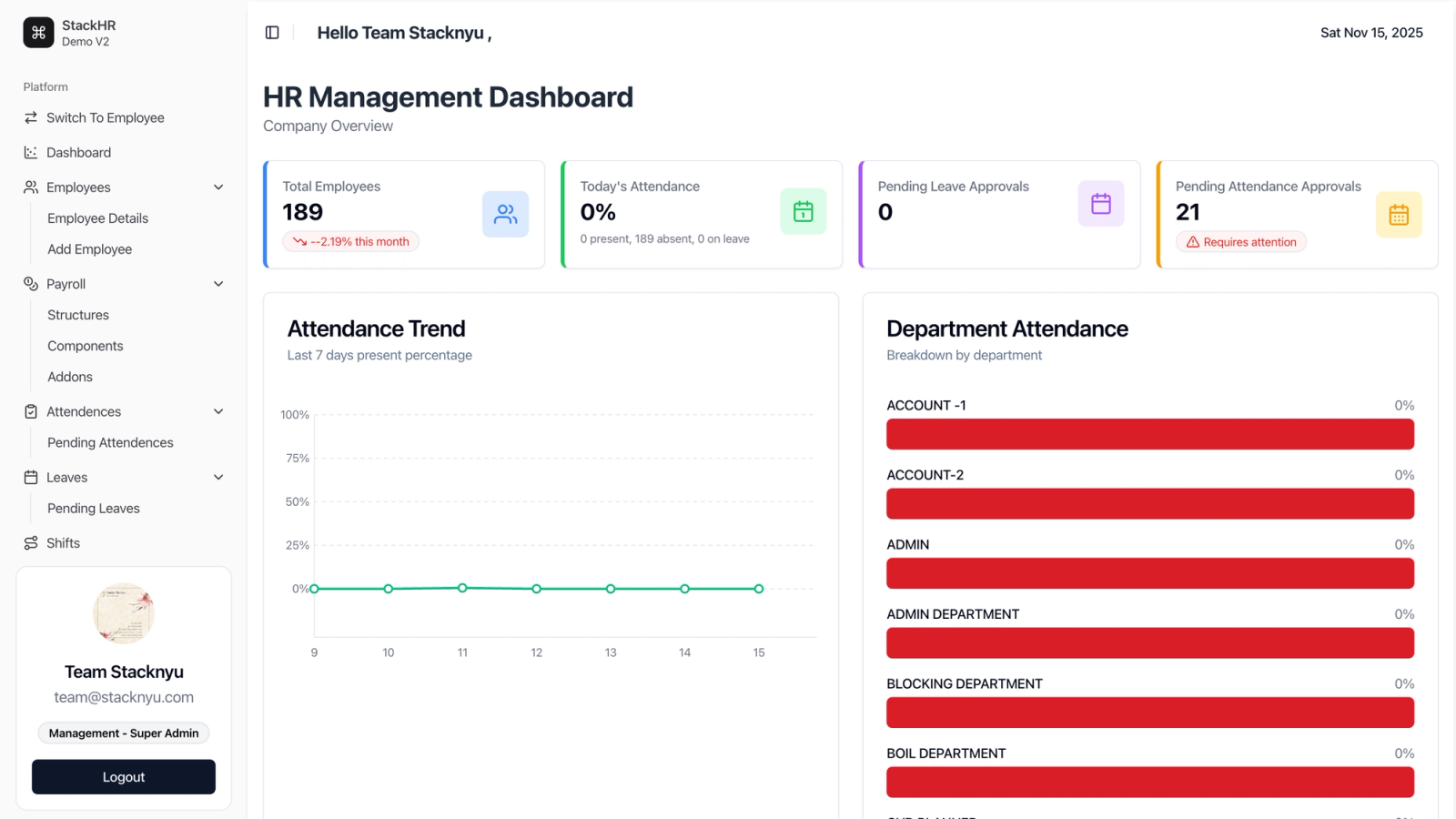
StackHR builds compliance-related adjustments directly into the same rule engine that handles branch-specific pay and attendance, rather than as a separate module bolted on afterward. Combined with a multi-level cost-center hierarchy and daily reporting, it gives finance visibility into compliance-related cost by branch, not just at the company level.
Frequently Asked Questions
Do PF and ESI rates differ by state?
No — PF and ESI are national schemes with fixed contribution rates. Professional Tax and the Labour Welfare Fund are the state-specific ones, and that's usually where multi-branch payroll gets complicated.
How many states levy Professional Tax?
Professional Tax is levied in 21 states and 1 union territory, each with its own slab structure. States including Delhi, Haryana, Uttar Pradesh, Punjab, Rajasthan, and Uttarakhand don't levy it at all, so a company operating nationally needs to track which branches are in scope and which aren't.
What happens if an employee transfers between branches in different states mid-year?
Their PT and LWF obligations generally follow their new work location going forward. This is exactly the kind of edge case that catches out payroll systems that treat compliance as a flat, company-wide setting rather than something tied to branch and state.
Is off-the-shelf payroll software enough for multi-state compliance?
For most companies, yes — established payroll platforms handle standard PF, ESI, PT, and LWF well. It becomes a harder question when compliance calculations need to interact with branch-specific pay structures or cost-center-level reporting the standard tool doesn't support.