Off-the-shelf HRMS platforms in India typically price by employee count, running roughly ₹40 to ₹200 per employee per month depending on features and vendor. A custom-built platform has no per-employee fee, but the cost driver shifts entirely to how many independently configurable rules — branch timings, holiday calendars, overtime formulas, cost-center hierarchies — the system needs to support from day one.
Who This Is For
- Multi-branch companies where per-employee HRMS pricing is starting to outweigh a custom build
- HR and finance leaders comparing subscription total cost of ownership against a one-time build
- Organisations with branch-specific pay rules an off-the-shelf tool can't model
- Anyone evaluating build vs buy for payroll and cost-center reporting
What Off-the-Shelf HRMS Actually Costs
Per-employee-per-month pricing in India generally runs ₹40 to ₹200 depending on features, with flat-fee plans starting around ₹3,495 a month for 25 to 50 employees. Many enterprise-focused platforms add a one-time setup fee of ₹10,000 to ₹50,000 for data migration and configuration, and first-year costs commonly run 1.5 to 2 times the advertised price once everything is included. None of this is fixed — always confirm directly with a vendor — but it's the honest starting range.
Where the Math Flips Toward Building
- Per-employee pricing scales with headcount forever — at 1,000 employees, even a modest ₹100-per-employee monthly subscription is roughly ₹12 lakh a year, indefinitely
- A packaged suite that can't model a specific rule forces HR into side spreadsheets — the real cost is the manual reconciliation those spreadsheets require every payroll cycle
- Multi-level cost-center reporting with cross-center audits and deficit reconciliation is rarely a standard HRMS feature at all — it's usually a separate finance tool bolted on top
Three Ways Companies Typically Approach This
Off-the-shelf HRMS: fastest to deploy, per-employee pricing, the right fit when policies are standard and locations are few.
HRMS plus side spreadsheets: what most growing multi-branch companies actually run — the invisible cost is reconciliation time and error rate, not a line item on any invoice.
Custom-built platform: highest upfront cost, no recurring per-employee fee, the only option that natively models branch-specific rules and cost-center hierarchy without workarounds.
What Actually Drives a Custom Build's Cost
- Number of independently configurable rule dimensions — timings, holidays, overtime, pay formulas
- Depth of cost-center hierarchy and how often reporting needs to run
- Compliance requirements — PF, ESI, PT, and LWF vary by state, and each adds real logic
- Document management and auto-expiry tracking as a first-class feature versus a bolt-on
- Historical payroll data migration
Case in Point
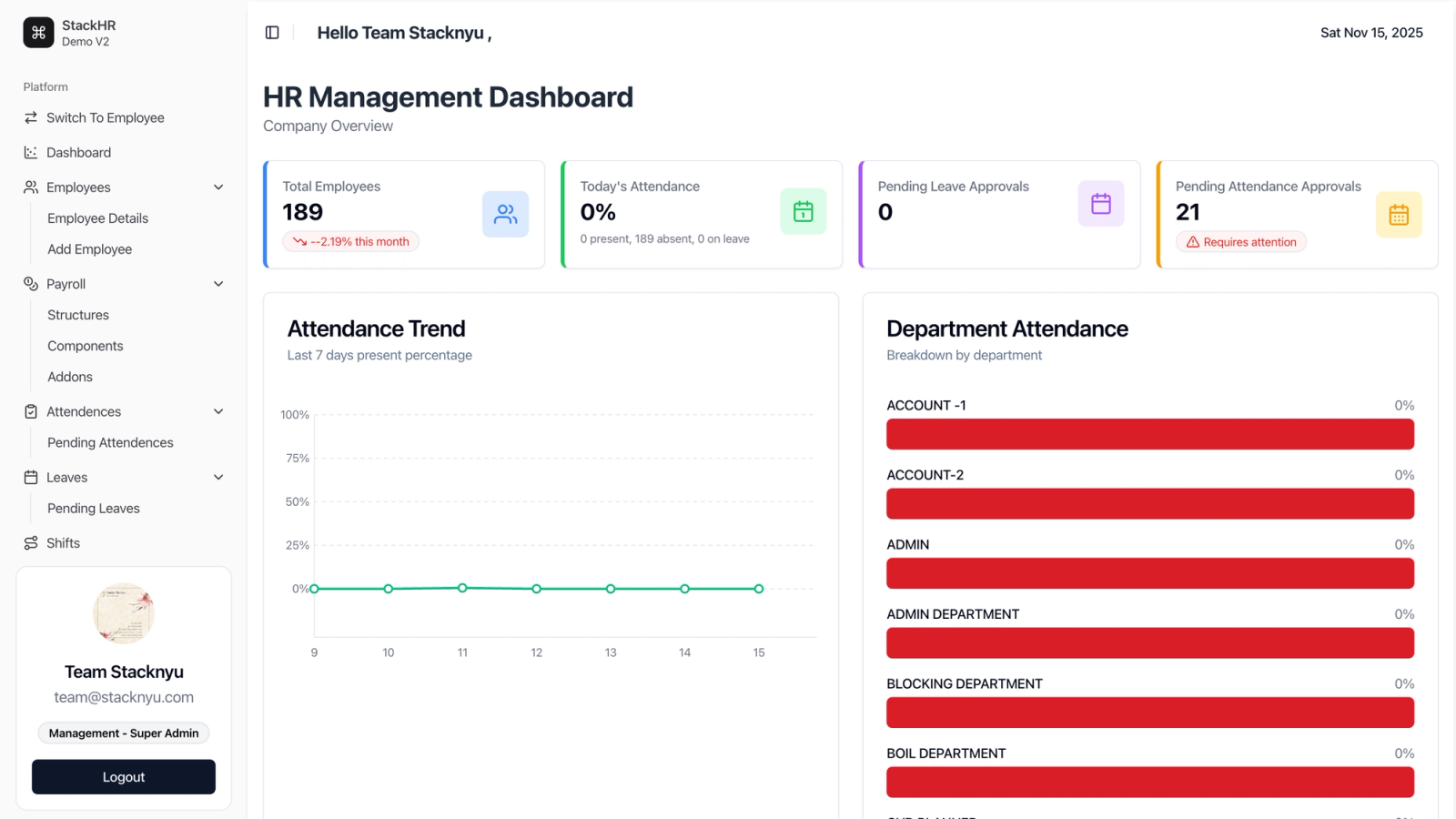
We built StackHR for organisations where branch timings, holidays, overtime rules, and pay structures genuinely differ by location. It now manages more than 1,000 employees and has processed over ₹10 crore in payroll, with cost centers tracked in a multi-level hierarchy that supports daily reporting, cross-center audits, and deficit reconciliation — capabilities that sit outside what most off-the-shelf HRMS platforms model.
Frequently Asked Questions
How much does a custom HRMS cost compared to an off-the-shelf subscription?
Off-the-shelf platforms scale their cost with headcount indefinitely — a per-employee fee that keeps growing every year you keep the software. A custom build has a larger upfront cost and no recurring per-employee fee, so the comparison depends on your five-year headcount trajectory, not just day-one price.
At what employee count does building custom make sense?
It's less about headcount and more about rule complexity. A 200-person company with genuinely branch-specific pay rules can outgrow off-the-shelf software faster than a 2,000-person company with one standard policy applied everywhere.
Do I need custom software just for PF, ESI, and PT compliance?
No — most off-the-shelf HRMS platforms handle standard PF, ESI, and PT calculations well. Custom software becomes worth it when compliance logic has to interact with branch-specific pay rules or a cost-center hierarchy the standard tool doesn't model.
What's the biggest hidden cost in off-the-shelf HRMS?
The rule your HRMS can't model. It doesn't show up as a line item — it shows up as a side spreadsheet HR maintains manually every payroll cycle, and the reconciliation time that spreadsheet requires.